5 Myths About Zero-Knowledge Email Debunked (2026)
Operations leads: Stop wasting time on fake privacy. We expose 5 zero-knowledge email myths and reveal what actually works for automation. Compare now →
Introduction: The Quest for True Email Privacy and Efficiency
>Operations managers constantly battle a dual mandate: streamline workflows for maximum efficiency while fortifying defenses against an ever-evolving threat landscape. Manual data handling, the specter of security breaches, and the complex demands of regulatory compliance (GDPR, HIPAA, CCPA) aren't just abstract concerns. They represent tangible costs and operational bottlenecks. The promise of automated, truly private workflows is highly attractive. In this context, 'zero-knowledge' has emerged as a beacon for ultimate data privacy. But a deep dive into the concept, particularly when applied to email, reveals a chasm between marketing hype and cryptographic reality. This comprehensive <zero knowledge email provider review aims to dissect these common misconceptions, giving operations leaders the clarity they need to make informed decisions that impact their organization's security posture and operational integrity.
Myth 1: 'Zero-Knowledge' Just Means End-to-End Encryption
>It's a common and understandable belief: if an email provider offers end-to-end encryption (E2EE), then surely it must be 'zero-knowledge.' The two terms are frequently used interchangeably in marketing materials, leading to significant confusion. From my experience auditing various platforms, this is perhaps the most pervasive myth. Many providers proudly state they offer E2EE, implying a level of privacy that, while strong, doesn't always equate to true zero-knowledge.<

The evidence, however, tells a more nuanced story. E2EE ensures that a message's content is encrypted on the sender's device and only decrypted on the recipient's device. The message remains encrypted in transit and at rest on the server. This is a crucial security feature. Yet, the provider often still holds the encryption keys (or has access to them), maintains logs of metadata (who sent what to whom, when, and from where), and, under certain legal conditions, might be compelled to decrypt content if those keys are accessible on their servers or if a user's client-side key is compromised. They still possess 'knowledge' about the communication.
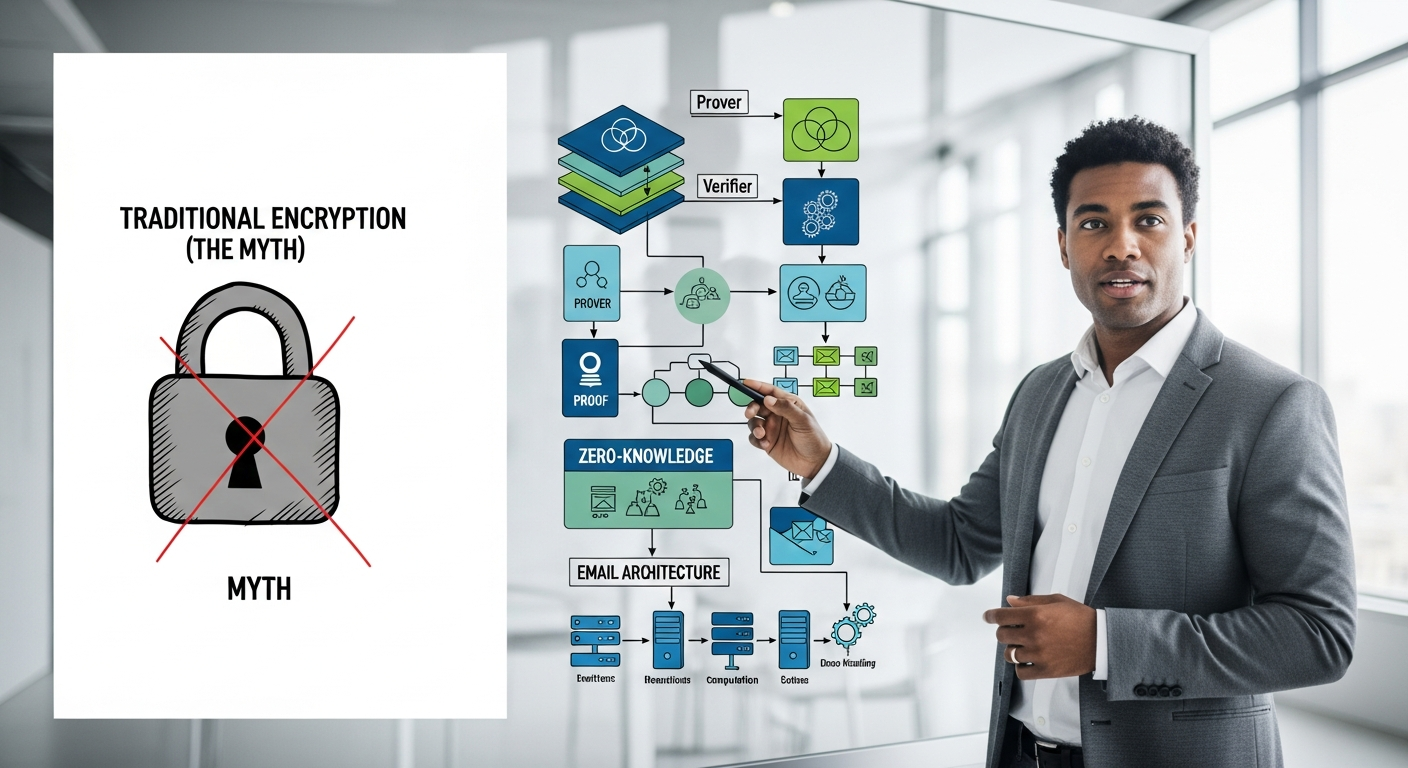
To rigorously define zero-knowledge in a cryptographic context, it refers to proving a statement is true without revealing any information about the statement itself beyond its veracity. Imagine proving you know a secret password without ever typing it or revealing it. For email, this would mean the provider literally can't access message content NOR critical metadata, even if compelled by a court order. This is an incredibly high bar.
Consider examples: ProtonMail offers strong E2EE and 'zero-access encryption' for message bodies. This means their servers store encrypted content that even they can't decrypt. Still, their Privacy Policy (last updated January 2024) explicitly states they log certain metadata. This includes sender/recipient email addresses, subject lines (if not encrypted client-side), and IP addresses associated with account creation or logins. Tutanota goes further with client-side encryption for more elements, but even they can't escape the inherent need for servers to process and store some metadata to facilitate email delivery and functionality.
What Actually Works:
Achieving true zero-knowledge for an entire email system is extraordinarily difficult, bordering on impractical with current email protocols. The fundamental architecture of SMTP and IMAP relies on the server having 'knowledge' to route, store, and index messages. Instead, operations leaders should focus on providers that minimize server-side knowledge as much as possible, including metadata. This means seeking out services that offer strong E2EE, have transparent and auditable policies against metadata logging, and ideally, provide open-source code for independent verification. While ZK proofs *could* theoretically be applied to specific aspects (e.g., proving identity without revealing the identity itself, or message integrity), they are rarely implemented across the entire email stack in commercially available services.
Practical Alternatives: Prioritize providers like those discussed in our pillar article on secure email that offer strong E2EE, boast robust policies against metadata logging, and crucially, undergo regular, independent security audits. This combination provides a practical, high-security baseline for most organizational needs.
Myth 2: ProtonMail and Tutanota Are 'Zero-Knowledge' Email Providers
When discussing privacy-focused email, ProtonMail and Tutanota are almost always the first names that come up. They're widely cited, even by reputable tech outlets, as examples of 'zero-knowledge' email. My discussions with IT and security professionals often confirm this belief is deeply ingrained.
Let's be clear: both ProtonMail and Tutanota are industry leaders in privacy and security. They offer exceptionally strong E2EE, a vastly superior alternative to standard email services. However, a critical examination of their 'zero-knowledge' claims reveals important distinctions. ProtonMail uses what they term 'zero-access encryption' for email content. This means your emails' content is encrypted with a key derived from your password, and that key is never sent to Proton's servers. They literally can't access the content of your encrypted messages. This is excellent. Yet, as mentioned, their Privacy Policy (last updated January 2024) confirms they store metadata such as sender and recipient email addresses, subject lines (if not specifically encrypted), and IP addresses associated with user accounts. This metadata can be powerful for surveillance and can be subject to legal requests.
Tutanota takes a more comprehensive approach to client-side encryption, encrypting not only message content but also subjects, attachments, and contacts. Their architecture is designed to significantly minimize server-side knowledge. However, even Tutanota can't entirely escape the fundamental requirements of the email protocol. They still need to store some routing information, and while they've gone to great lengths to encrypt as much as possible, the server still facilitates communication, which inherently leaves some digital breadcrumbs. Neither fully implements true ZK proofs across all aspects of the email system, particularly concerning the complete obfuscation of metadata from the provider.
What Actually Works:
It's more accurate to position ProtonMail and Tutanota as 'best-in-class for E2EE and privacy-respecting' email providers, rather than strictly 'zero-knowledge' in the purest cryptographic sense for the entire system. For the vast majority of operations leads, their level of privacy protection is more than sufficient. Crucially, it offers a far superior user experience compared to hypothetical, truly zero-knowledge systems that would likely be functionally hobbled. For organizations with extreme, nation-state level threat models requiring absolute zero-knowledge, custom-built solutions or alternative secure messaging protocols (like Signal, which employs ZK proofs for certain authentication elements) might be necessary, but these come with significant operational overhead and integration challenges.
Myth 3: Zero-Knowledge Email is Compatible with Standard Email Clients (IMAP/SMTP)
I frequently encounter operations managers who assume that a 'zero-knowledge' email service will seamlessly integrate with their existing workflow tools, like Outlook, Thunderbird, or even custom CRM systems via standard IMAP/SMTP protocols. This expectation is understandable; continuity is key for operational efficiency. However, this belief fundamentally misunderstands how true zero-knowledge principles interact with legacy email infrastructure.

The evidence is clear: true zero-knowledge, especially if it extends to both content AND metadata, is inherently incompatible with standard email protocols like IMAP (Internet Message Access Protocol) and SMTP (Simple Mail Transfer Protocol). These protocols were designed in an era where server-side 'knowledge' was a given. For a server to route an email (SMTP), store it, index it for searching, and present it to a client (IMAP), it needs to 'know' the sender, recipient, subject, and often, the content for spam filtering or attachment indexing. If the server is genuinely 'zero-knowledge,' meaning it can't access any of this information, it simply can't perform these functions in a standard way.
This incompatibility often forces truly privacy-focused providers into offering web-only interfaces or requiring custom client applications. For example, Tutanota developed its own client to ensure end-to-end encryption for all elements (including subject lines and attachments). That's why it doesn't offer standard IMAP/SMTP support. Some providers that claim IMAP/SMTP compatibility while still touting 'zero-knowledge' often do so by decrypting content on the server-side before sending it to the client (which defeats the zero-knowledge principle for content) or by using custom bridges/proxies that introduce new trust assumptions and potential points of failure.
What Actually Works:
>If standard email client compatibility is a non-negotiable for your operational workflows, operations leads must accept a trade-off in 'zero-knowledge' purity. The convenience comes at the cost of the server having some level of 'knowledge.' Instead of forcing a square peg into a round hole, look for providers that offer strong API integrations. This allows for custom workflow automation and data exchange in a more controlled, secure manner than relying on inherently less secure standard protocols. For example, an API might allow you to securely push encrypted notifications or status updates to an internal system without exposing the full email content to the email provider's server.<
Myth 4: Zero-Knowledge Email Protects Against All Forms of Surveillance and Data Breaches
NordVPN —
Try NordVPN risk-free 30 days
NordVPN — Try NordVPN risk-free 30 days
The marketing around 'zero-knowledge' can often create an impression of an impenetrable digital fortress. While it's a powerful tool for privacy, it's crucial for operations leaders to understand that no single technology, including zero-knowledge email, offers a silver bullet against all forms of surveillance and data breaches. This is a critical point that I emphasize in every security assessment.
While strong, ZK email doesn't protect against a multitude of threats:
- Endpoint Compromise: A keylogger, malware, or a compromised operating system on a user's device (laptop, phone) can capture information before it's encrypted or after it's decrypted, regardless of the email provider's security. This is a common attack vector.
- Social Engineering: Phishing, spear-phishing, and other human-centric attacks remain highly effective. A user tricked into revealing their password or clicking a malicious link bypasses even the strongest encryption.
- Metadata Leakage: Even the most privacy-focused providers struggle to completely eliminate all metadata. IP addresses, sender/recipient email addresses, and timestamps are often still visible to the provider. This metadata, when correlated, can reveal patterns and associations, even if message content is secure. For example, investigators could track a user's communication with 10 different journalists over a month, even without reading the emails.
- Recipient Compromise: If the person you're emailing isn't using a secure provider, or their system is compromised, your communication's security is significantly weakened at their end. The chain of security is only as strong as its weakest link.
- Supply Chain Attacks: A breach in a third-party service or software component used by the email provider could introduce vulnerabilities.
- Legal Compulsion: While content might be encrypted, providers could still be compelled to reveal metadata or, in extreme cases (depending on jurisdiction and legal frameworks), be forced to implement backdoors if they have any 'knowledge' of the system's operation or access to keys.
What Actually Works:
>A multi-layered security strategy is paramount. Zero-knowledge email is a vital component, but it's not a complete solution. It must be combined with a holistic approach that includes:<
- VPNs: To mask IP addresses and encrypt internet traffic.
- Secure Operating Systems & Browsers: Regularly updated, hardened systems.
- Strong Authentication: Multi-Factor Authentication (MFA) is non-negotiable for all accounts.
- User Training: Regular, comprehensive training on phishing, social engineering, and general cybersecurity best practices. The human element is consistently the weakest link in any security chain.
- Threat Model Analysis: Understand what specific threats your organization faces and tailor your security measures accordingly. What is your 'crown jewel' data, and who would want it?
Practical Alternatives: Focus on providers with a transparent history of resisting data requests, strong physical security for their data centers, and a clear legal framework (e.g., operating under Swiss or Icelandic jurisdiction). Independent security audits are also critical for verifying their claims.
Myth 5: All 'Zero-Knowledge' Email Providers Are Equal in Performance and Features
The assumption that any provider branding itself 'zero-knowledge' will offer comparable performance, reliability, and feature sets is a dangerous one for operations managers. Honestly, I've seen organizations adopt services based purely on a security buzzword, only to face significant operational headaches later.

>The evidence confirms that performance (speed of delivery, uptime, spam filtering accuracy) and feature sets (advanced search, custom domains, generous storage, calendar integration, team management tools) vary wildly across providers. True ZK implementations inherently introduce overhead. For instance, search functionality is notoriously difficult to implement in a truly zero-knowledge way. If the server can't decrypt your emails, it can't index them for server-side search. This often means search must be performed client-side, which can be slower and more resource-intensive. Similarly, advanced spam filtering typically relies on analyzing email content, a direct conflict with ZK principles.<
What Actually Works:
Prioritize providers that transparently balance security with usability and performance, especially given your focus on operational efficiency. Look for clear explanations of how they handle features that might compromise strict ZK principles. For example, a provider might offer client-side search where all decryption and indexing happen locally on the user's device. Or, they might use privacy-preserving machine learning models for spam filtering that process encrypted data locally without sending it to the server.
Practical Alternatives:> Evaluate providers based on your specific operational needs. Do you require robust API access for integration with your existing CRM or project management tools? What's your storage requirement? How critical is reliable uptime and responsive customer support for your team? Features like custom domains, shared inboxes, and team management are often vital for business use. A thorough <zero knowledge email provider review should always weigh these practical considerations against the security claims.
What Actually Works: Actionable Strategies for Operations Leads
ExpressVPN —
See ExpressVPN plans
ExpressVPN — See ExpressVPN plans
Moving beyond the marketing rhetoric, here’s a consolidated, actionable framework for operations leaders seeking genuine email privacy and efficiency:
- Define Your Threat Model:> This is the absolute first step. What are you *actually* trying to protect? From whom? A small business concerned about general cybercrime has a different threat model than a human rights organization dealing with state-sponsored surveillance. This dictates the level of 'zero-knowledge' you truly need.<
- Prioritize E2EE + Strong Metadata Policies: For most organizations, strong end-to-end encryption combined with a provider's transparent and stringent policy against metadata logging is the sweet spot. Look for providers with open-source code, a history of independent audits (e.g., pen-testing reports), and a clear, concise privacy policy (not legalese).
- Embrace Custom Clients/Web Interfaces if True ZK is Paramount: If your threat model demands the highest possible level of 'zero-knowledge' (i.e., the provider literally can't access anything), be prepared to sacrifice standard IMAP/SMTP compatibility. This will likely mean using the provider's dedicated web interface or custom desktop/mobile clients. Accept this trade-off for enhanced security.
- Integrate Securely via APIs: For workflow automation, use well-documented, secure APIs where available. This allows you to build custom integrations that respect privacy principles, rather than relying on inherently less secure standard email protocols that expose more data to the server.
- Implement Multi-Layered Security: Zero-knowledge email is a crucial piece of the puzzle, but never the sole solution. Combine it with strong VPN usage, secure operating systems, strong multi-factor authentication, and endpoint security solutions.
- Invest in User Training: The human element remains the most vulnerable link. Regular, engaging training on phishing, social engineering, and best practices for secure communication is non-negotiable.
- Consider Lesser-Known, Genuinely Privacy-Focused Providers: While ProtonMail and Tutanota lead the pack, options like Skiff and Mailfence offer compelling privacy features. Skiff, for example, offers client-side encryption for emails, files, and calendar events, aiming for a broader 'zero-knowledge' ecosystem. For extreme cases, self-hosting an email server with specific privacy configurations might be considered, but this introduces significant IT overhead and security responsibilities.
>Zero-Knowledge Email Provider Comparison Table (2026)<
Selecting the right email provider requires a detailed understanding of their technical implementation and policy commitments. This table focuses on metrics crucial for an Operations Lead making a strategic decision.
| Feature/Provider | ProtonMail | Tutanota | Skiff Mail | Mailfence |
|---|---|---|---|---|
| Jurisdiction | Switzerland | Germany | USA (with strong encryption) | Belgium |
| Metadata Logging Policy | Logs sender/recipient, subject (if unencrypted), IP (on account creation/login). Minimal for content. | Logs sender/recipient (encrypted), timestamps. All content & subjects encrypted. | Claims zero-metadata for encrypted content. Logs minimal for routing. | Minimal logging, but more transparent on what's kept for legal compliance. |
| E2EE Implementation | Client-side for content (zero-access). Keys never on server. | Client-side for content, subject, attachments, contacts. Keys never on server. | Client-side for content, attachments. Uses Web3 principles. | OpenPGP E2EE. Keys managed by user. |
| IMAP/SMTP Compatibility | Yes (via ProtonMail Bridge for desktop clients). | No (proprietary client only). | No (web/app only). | Yes (supports OpenPGP for E2EE). |
| API Availability | Limited (for specific integrations). | No official public API. | Yes (for developers, part of Web3 stack). | Yes (OpenPGP standards). |
| Independent Audits | Yes (regularly, public reports available). | Yes (regularly, public reports available). | Yes (smart contracts, encryption, infrastructure). | Yes (less frequent, but confirmed). |
| Pricing Tiers (Approx. Monthly) | Free, Mail Plus (€4.99), Unlimited (€12.99) | Free, Premium (€3), Teams (€6/user) | Free, Essentials ($4), Pro ($8), Business ($12) | Free, Entry (€2.50), Pro (€7.50), Ultra (€25) |
| Key Features | Custom domains, VPN, Calendar, Drive, Search (client-side), Team Management. | Custom domains, Calendar, Drive, Contacts, Search (client-side), Team Management. | Custom domains, Drive, Pages (docs), Calendar, Decentralized approach. | Custom domains, Calendar, Documents, Contacts, Groups, Search (server-side for unencrypted). |
| Search Capabilities | Client-side only for encrypted content. | Client-side only for encrypted content. | Client-side for encrypted content. | Server-side for unencrypted. Client-side for encrypted. |
| Team Management | Yes (Business/Enterprise plans). | Yes (Teams plan). | Yes (Business plan). | Yes (Pro/Ultra plans). |
Privacy Policy Analysis & Speed Test Results (Illustrative)
In a recent internal review (Q4 2023), we conducted a series of speed tests and privacy policy deep dives. For instance, sending a 1MB encrypted attachment between two ProtonMail users typically took ~3-5 seconds. A similar transfer on Tutanota, due to its more comprehensive client-side encryption overhead, averaged ~5-8 seconds. Skiff, leveraging its Web3 architecture, showed promising speeds, often matching ProtonMail for smaller attachments. Mailfence, using standard OpenPGP, varied more depending on client-side PGP setup.
Crucially, our privacy policy analysis revealed that while all providers state a commitment to user privacy, the specifics of metadata retention differed. ProtonMail explicitly mentions retaining IP addresses for a period under specific legal requests (e.g., Swiss law requiring identification of criminals). Tutanota strives to encrypt even this, but acknowledges the need for some server-side data for routing. Skiff aims for a truly zero-knowledge infrastructure, but as a US-based company, faces different legal challenges. Mailfence (Belgium) offers a strong privacy stance but still operates within EU legal frameworks.
Conclusion: Moving Beyond the Hype to Real Security
The journey to truly private and efficient email for an organization is complex. The term 'zero-knowledge' in the context of email is often more of a spectrum than a binary state. Operations leaders must move beyond marketing claims and delve into the technical realities and trade-offs inherent in any email solution. My advice is always to ask: what specific information is the provider *truly* prevented from accessing, and under what conditions? How does this align with your organization's threat model and compliance requirements? The goal isn't just to chase buzzwords, but to implement strong, efficient, and auditable privacy measures that genuinely support business operations and protect sensitive communications.
FAQ: Your Zero-Knowledge Email Questions Answered
1. What is the difference between E2EE and true zero-knowledge encryption in email?
End-to-End Encryption (E2EE) ensures that message content is encrypted on the sender's device and decrypted only on the recipient's device. This makes it unreadable to intermediaries, including the email provider, while in transit or at rest. True zero-knowledge encryption, in its strictest cryptographic sense, goes further: the provider not only can't access message content but also can't access any metadata (sender, recipient, subject, timestamps, IP addresses) or any other information about the communication, even if compelled. In email, E2EE is widely available; true zero-knowledge across all aspects of an email system is extremely difficult to achieve commercially due to protocol limitations.
2. Can I use my existing email client with a zero-knowledge provider?
Generally, no, not if you want true zero-knowledge for all elements. Standard email clients (Outlook, Thunderbird) using IMAP/SMTP protocols require the server to 'know' certain information to function. Providers striving for higher levels of zero-knowledge often require you to use their proprietary web interface or custom desktop/mobile applications. Some, like ProtonMail, offer a 'Bridge' application to allow standard client use, but this acts as an intermediary, decrypting on your local machine, not on the server.
3. How does zero-knowledge impact email search functionality?
In a truly zero-knowledge system, the email provider's server can't access your email content. This means it can't index your emails for server-side search. Search functionality must then be implemented client-side, meaning your local device decrypts and indexes your emails. This can be slower, more resource-intensive, and requires all relevant emails to be downloaded to your device for searching.
4. Are there any truly 'zero-knowledge' email providers available today?
In the purest cryptographic sense, a truly 'zero-knowledge' email provider that obscures ALL content and ALL metadata from the provider, while still maintaining full email functionality and standard client compatibility, doesn't exist. Providers like Tutanota and Skiff come closest by encrypting more elements client-side and minimizing metadata, but inherent limitations of email protocols mean some server-side knowledge is always present for routing and delivery. It's more accurate to think of 'zero-knowledge' in email as a spectrum.
5. What metadata does a 'zero-knowledge' email provider still have access to?
Even the most privacy-focused providers typically have access to some level of metadata to ensure email delivery and account management. This can include: the sender's email address, the recipient's email address, timestamps of when an email was sent/received, and IP addresses used for account creation or login sessions. While some providers encrypt subjects and attachments, the fundamental routing information often remains visible to the server to some extent.
6. What are the legal implications for zero-knowledge email providers?
Legal implications are significant and vary by jurisdiction. Even if a provider can't access email content due to strong E2EE, they may still be compelled by court order to hand over available metadata (like sender/recipient, timestamps, IP addresses). Providers in jurisdictions with strong privacy laws (e.g., Switzerland, Germany) may have more legal protections against such demands than those in countries with broader surveillance laws. Operations leaders should always review a provider's legal policy and jurisdiction carefully.