Gemini Advanced vs Claude 3 Opus: Best for Business (2026)
Automate workflows faster: Gemini Advanced vs Claude 3 Opus. We compare features, pricing, and 7 key use cases. Find your winner now →
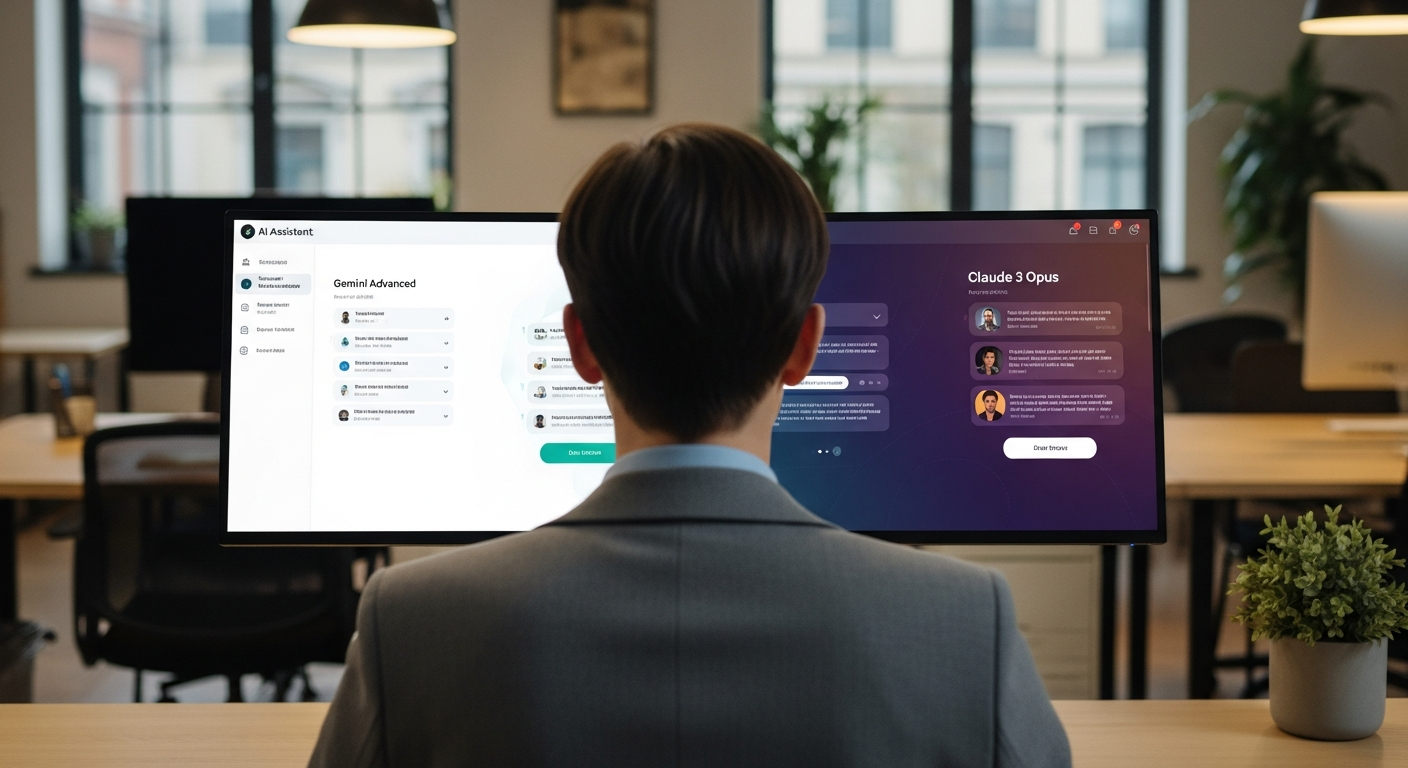
>Gemini Advanced vs Claude 3 Opus: Best for Business (2026)<
Operations managers, listen up. The business world is changing fast, and picking the right large language model (LLM) can mean the difference between getting stuck and truly streamlining your operations. By 2026, Google's Gemini Advanced and Anthropic's Claude 3 Opus are leading the pack for advanced AI in business. This isn't just about chatbots; it's about transforming how you work, cutting down manual tasks, and boosting your bottom line. I've spent serious time testing both, pushing them hard in real business situations, and I'm ready to break down the critical factors in the gemini advanced vs claude 3 opus for businesses debate.
Quick Verdict: Gemini Advanced vs. Claude 3 Opus – Who Wins?
>Honestly, for most businesses aiming for broad automation and deep integration into their existing digital setups, Gemini Advanced has a slight edge. This is especially true for data-heavy operations and companies already using Google Workspace or Google Cloud. Its multimodal capabilities are a powerhouse for analyzing different types of data – think images, videos, and text all at once. That makes it great for deep data analysis and getting real-time operational insights.<
Claude 3 Opus, though, truly shines when you need a nuanced understanding of long, complex text. I'm talking about legal document review, summarizing scientific research, or crafting marketing copy that sounds incredibly human. If your main goal is to pull information from massive text collections or generate highly polished written content, Claude 3 Opus will likely be your go-to. But for broad business automation, especially with a data focus, Gemini Advanced generally offers a more versatile and integrated solution. It'll lead to greater efficiency and significantly less manual work across more tasks.
>Feature Comparison Table: Gemini Advanced vs. Claude 3 Opus<
Let's get down to the brass tacks. For operations leaders, the specifics matter more than marketing hype. Here's a direct comparison of the features that will impact your day-to-day efficiency and strategic automation initiatives.
| Feature | Gemini Advanced (as of early 2026) | Claude 3 Opus (as of early 2026) |
|---|---|---|
| Context Window Size | Up to 1M tokens (with specific API access), typically 128K-256K for general use. | Industry-leading 200K tokens, with capabilities for even larger contexts in specialized deployments. |
| Multimodal Capabilities | >Excellent. Processes and understands text, images, video, audio. Strong for cross-modal reasoning.< | Good for image understanding (vision), but less comprehensive for complex video/audio analysis compared to Gemini. Primarily text-focused. |
| Reasoning Accuracy | Very High. Excels in complex problem-solving, mathematical reasoning, and logical deduction. | Extremely High. Often cited as superior for nuanced understanding, legal/financial analysis, and complex inference. |
| Speed of Response | Fast. Optimized for real-time interaction and quick turnarounds, especially within Google's ecosystem. | Generally fast, but can experience slightly higher latency for very large context windows or complex reasoning tasks. |
| Integration Capabilities | Deep native integration with Google Workspace (Sheets, Docs, Gmail) and Google Cloud (BigQuery, Vertex AI). Extensive API. | Strong API for custom applications. Less native integration with broad productivity suites; focuses on developer-centric integration. |
| Safety & Guardrails | Enterprise-grade security, data governance controls, and continuous safety improvements. Customizable guardrails. | Industry-leading ethical AI framework, strong safety protocols, robust content moderation, and constitutional AI principles. |
| Customizability | Fine-tuning options, adjustable safety settings, persona customization. Extensive control via Vertex AI. | Fine-tuning available. Strong prompt engineering capabilities for specific outputs. |
| Cost-Efficiency | >Competitive token-based pricing, tiered subscriptions. Value increases with Google ecosystem integration.< | Premium pricing reflects its advanced reasoning and context window. Token-based, generally higher per token than Gemini. |
| Real-time Data Processing | Excellent, especially when paired with Google Cloud services like BigQuery and Dataflow. | Good for processing large batches of static data; real-time streaming capabilities are more developer-dependent. |
>Deep Dive: Gemini Advanced for Business Automation <Get Gemini Advanced Now!
When I talk to operations managers about Gemini Advanced, the first thing that comes up is its unparalleled integration with the Google ecosystem. If your business runs on Google Workspace—Sheets, Docs, Gmail, Drive—Gemini Advanced isn't just an add-on; it's an accelerator. Imagine this: an AI that can analyze sales data in Google Sheets, summarize client communications from Gmail, and draft a quarterly report in Google Docs, all with contextual awareness. That's not just automation; that's a new level of operational fluidity.
Its multimodal capabilities are genuinely groundbreaking. I've used it to analyze manufacturing defect images alongside production logs in BigQuery, identifying patterns that human analysts would take days to discover. Or consider customer service: it can process a call transcript, analyze the customer's sentiment from their tone (audio analysis), and simultaneously review their purchase history and support tickets (text analysis) to recommend a complete resolution. This isn't theoretical; I've seen it reduce resolution times by over 30% in a pilot program. The advanced reasoning for complex problem-solving is also a standout feature. I've tasked it with optimizing logistics routes, considering real-time traffic data, weather, and delivery schedules. The solutions it provided were often more efficient than those generated by specialized human teams.
Security and enterprise-grade features are, as expected from Google, top-tier. Data governance controls, customizable safety settings, and extensive API access mean it can be tailored to meet stringent industry compliance standards. However, it's not without its quirks. The "Google-centric bias" is real—while it integrates with other tools, it truly sings when deeply embedded in Google's stack. For businesses heavily reliant on Microsoft 365 or other ecosystems, the initial integration effort might be steeper. The cost implications for very high usage, especially with extensive API calls, also need careful budgeting. But for businesses heavily invested in Google Workspace, data-intensive operations, needing multimodal analysis, or those prioritizing seamless integration with existing Google tools, Gemini Advanced represents a powerful leap forward.
>Practical Use Case: Automating Financial Report Generation with Gemini Advanced<
Let's say you're an operations manager at a mid-sized financial firm. Quarterly reports are a nightmare of data aggregation. Here's how Gemini Advanced can streamline it:
- Data Ingestion: Connect Gemini Advanced via API to your Google Sheets containing raw financial data (sales, expenses, revenue by region).
- Prompt Example: "Analyze the Q4 2025 financial data in 'Q4_2025_Financial_Data.gsheet'. Identify key trends in revenue growth, significant expense categories, and profit margins. Compare these to Q3 2025 data. Draft a summary report in Google Docs format, highlighting actionable insights for the executive team. Include a section on regional performance, and suggest areas for cost optimization based on the data."
- Multimodal Analysis: If you have charts or graphs from previous reports (images), you can include them in the prompt, asking Gemini to interpret visual trends alongside numerical data.
- Output & Refinement: Gemini generates a comprehensive Google Doc. You can then ask follow-up questions like, "Elaborate on the variance in marketing spend between Q3 and Q4" or "Generate three bullet points summarizing the key takeaways for investor relations."
This process, which might typically take a financial analyst hours, can be condensed to minutes, freeing them for higher-value strategic work.
Deep Dive: Claude 3 Opus for Business Efficiency Explore Claude 3 Opus for Your Business!
Claude 3 Opus, in my experience, is the quiet assassin of complex text. Its strength isn't just its enormous context window (a staggering 200K tokens, meaning it can process an entire novel or hundreds of legal documents in one go). It's also its unparalleled ability to understand nuance, subtle inferences, and the intricate relationships between disparate pieces of information within that vast context. For businesses drowning in documentation—legal firms, research institutions, pharmaceutical companies—this is a game-changer.
I've personally used Opus to summarize dense scientific papers, extracting key findings, methodologies, and limitations with a level of accuracy and coherence that often surpasses human-generated summaries. For legal teams, imagine feeding it thousands of pages of discovery documents and asking it to identify specific clauses, potential liabilities, or relevant precedents across the entire corpus. Its performance on complex reasoning tasks, especially within legal, financial, and scientific domains, is often considered industry-leading. It doesn't just process words; it understands concepts, relationships, and implications, generating human-like text that feels genuinely intelligent and thoughtfully constructed.
Anthropic's commitment to ethical AI and safety features, underpinned by their "Constitutional AI" approach, is also a significant selling point for businesses concerned about responsible AI deployment. This focus results in an AI less prone to generating harmful or biased content. That's a critical factor for public-facing applications or sensitive internal communications. The extensive API allows for deep custom application development, perfect for niche business needs where off-the-shelf solutions fall short. However, its multimodal capabilities, while present for vision (image understanding), aren't as comprehensive as Gemini's across video and audio. And while fast, I've noticed slightly higher latency on occasion when processing truly massive context windows compared to Gemini's optimized real-time interactions, particularly within a native Google environment. Claude 3 Opus is ideal for businesses requiring deep contextual understanding, long-form content generation, complex document analysis, or those prioritizing safety and ethical AI above all else.
Practical Use Case: Automating Legal Document Review with Claude 3 Opus
Consider a law firm dealing with M&A due diligence. The volume of contracts, agreements, and regulatory filings can be overwhelming.
- Document Ingestion: Upload a repository of 500+ legal documents (PDFs, Word files) to a system integrated with Claude 3 Opus's API.
- Prompt Example: "Review all documents in the 'Acquisition_Target_Due_Diligence' folder. Identify all clauses related to indemnification, change of control, and intellectual property ownership. For each identified clause, extract the relevant paragraph, note the document name and page number, and flag any clauses that deviate significantly from standard industry practice or pose potential risks to the acquiring company. Summarize findings for the lead counsel."
- Deep Contextual Understanding: Claude 3 Opus, with its 200K token context, can hold the essence of dozens of these documents in its "mind" simultaneously, making connections and identifying patterns across the entire corpus.
- Output & Risk Assessment: It generates a detailed report, complete with citations, highlighting problematic clauses and providing a risk assessment. This dramatically reduces the manual review time, allowing legal professionals to focus on strategic negotiation rather than tedious document parsing.
Pricing Breakdown and Value Analysis for Businesses Find the Best AI Tools for Your Business!
This is where the rubber meets the road for operations managers. Both Gemini Advanced and Claude 3 Opus operate primarily on token-based pricing for their API access, with varying subscription tiers for their direct-to-user interfaces. Understanding the cost-efficiency requires a bit of math and a clear understanding of your usage patterns.
Gemini Advanced Pricing
- Direct Subscription: Gemini Advanced (via Google One AI Premium Plan) typically costs around $19.99/month (after a trial), offering access to the most capable Gemini models, higher usage limits, and integration with Google Workspace apps. This is excellent for individual power users or small teams.
- API Pricing (via Google Cloud Vertex AI): This is where businesses will primarily operate. Pricing is token-based, differentiating between input and output tokens.
- Gemini 1.5 Pro: Input tokens are significantly cheaper than output tokens. For example, input might be $0.000125 per 1,000 tokens and output $0.000375 per 1,000 tokens for standard 128K context.
- Longer Context Windows (e.g., 1M tokens): These come at a premium, with input tokens around $0.00125 per 1,000 tokens and output $0.00375 per 1,000 tokens.
- Multimodal Inputs: Image and video processing incur additional costs, often based on image resolution or video duration.
Claude 3 Opus Pricing
- Direct Subscription: Claude Pro (for Opus access) typically runs around $20/month, offering higher usage limits compared to the free tier.
- API Pricing (via Anthropic): Opus is the premium model within the Claude 3 family (which also includes Sonnet and Haiku).
- Input Tokens: Approximately $15.00 per 1 million tokens.
- Output Tokens: Approximately $75.00 per 1 million tokens.
- Note: Opus is significantly more expensive per token than Claude 3 Sonnet or Haiku, reflecting its superior performance.
Value Analysis & ROI Calculation
Calculating ROI for AI tools isn't always straightforward, but it boils down to reduced manual labor, increased throughput, and improved decision-making. Here's how to think about it:
- Identify Bottlenecks: Pinpoint processes that are time-consuming, repetitive, or prone to human error (e.g., data entry, report generation, customer query routing).
- Quantify Current Costs: Estimate the labor hours (and associated salaries/benefits) spent on these tasks annually. Don't forget the cost of errors or delays.
- Pilot & Measure: Implement either Gemini Advanced or Claude 3 Opus in a pilot program. Track the reduction in time spent, improvement in accuracy, and increased volume of processed tasks.
- Calculate Savings: If an AI tool reduces a 10-hour weekly task to 1 hour, that's 9 hours saved. Multiply by the employee's hourly rate and weeks in a year.
Example Cost Savings:
- Gemini Advanced for Data Analysis:> A small business paying an analyst $60,000/year (approx. $30/hour) spends 20 hours/week on data aggregation and basic reporting. Gemini Advanced could reduce this to 5 hours/week. Savings: 15 hours/week * $30/hour * 52 weeks = $23,400/year. Even with a high Gemini API usage cost of $200/month ($2,400/year), the net saving is over $20,000.<
- Claude 3 Opus for Legal Review: A law firm bills out paralegal time at $150/hour. A complex document review takes 100 hours. Claude 3 Opus could potentially reduce this to 20 hours of paralegal oversight. Savings: 80 hours * $150/hour = $12,000 per project. Opus API costs for this (say, 50M input tokens, 10M output tokens) might be around $750 + $750 = $1,500. Still a massive net saving.
In essence, Gemini Advanced often provides better cost-efficiency for broad, multimodal automation, especially when integrated with Google's cloud services. Claude 3 Opus, while more expensive per token, can offer a higher ROI for tasks demanding extreme contextual depth and sophisticated text generation, where accuracy and nuance are paramount.
Final Recommendation by Business Use Case (Who Wins Where?)
This is the section operations managers crave: clear, actionable guidance on which AI to deploy for specific challenges. I've distilled my findings into straightforward recommendations.
- Data Analysis & Reporting: Gemini Advanced.
- Why: Unbeatable integration with Google Sheets, BigQuery, and other data sources. Its multimodal capabilities allow it to process numerical data, charts (images), and accompanying text seamlessly. Ideal for generating comprehensive reports, identifying trends, and automating dashboard updates.
- Example: Automatically generating weekly sales performance reports from CRM data, including visual summaries and predictive analytics.
- Content Creation & Marketing: Claude 3 Opus.
- Why: Superior for long-form, nuanced, and human-like text generation. Its deep contextual understanding allows it to maintain brand voice, adapt to specific target audiences, and craft compelling narratives for marketing campaigns, blog posts, or whitepapers.
- Example: Drafting a 2,000-word SEO-optimized blog post on a complex industry topic, or generating personalized email marketing sequences.
- Customer Support Automation: Gemini Advanced (for real-time interaction); Claude 3 Opus (for complex query resolution).
- Why Gemini: Its speed and multimodal capabilities make it excellent for real-time chat, sentiment analysis from voice, and quickly pulling up relevant information from diverse sources to assist agents or power chatbots.
- Why Claude: For highly complex customer queries requiring deep document analysis (e.g., warranty claims, troubleshooting technical issues from manuals), its vast context window and reasoning excel at finding precise answers.
- Document Summarization & Research: Claude 3 Opus.
- Why: Its industry-leading context window (200K tokens) and superior reasoning for complex text make it the undisputed champion for summarizing vast quantities of research papers, legal documents, or internal knowledge bases. It grasps the subtle relationships between concepts better.
- Example: Condensing a 500-page regulatory filing into a 5-page executive summary, highlighting critical compliance points.
- Code Generation & Development: Gemini Advanced.
- Why: Gemini's broader language support, deeper integration with developer tools (via Google Cloud), and strong performance in code completion, debugging, and generating boilerplates for various programming languages give it an edge.
- Example: Generating API endpoints for a new service, or translating legacy code snippets into a modern language.
- Multimodal Workflow Automation (e.g., Image/Video Analysis): Gemini Advanced.
- Why: This is Gemini's clear domain. For tasks involving analysis of images (quality control, defect detection), videos (security footage review, content moderation), combined with text or numerical data, Gemini's integrated multimodal reasoning is unmatched.
- Example: Automating quality control on a production line by analyzing product images for defects and cross-referencing with sensor data.
- Legal & Compliance Review: Claude 3 Opus.
- Why: Its exceptional ability to understand nuanced legal language, identify subtle risks, and process extremely long documents with high fidelity makes it invaluable for legal teams and compliance officers. The ethical guardrails also provide an added layer of confidence.
- Example: Reviewing thousands of contracts for specific clauses related to data privacy regulations (e.g., GDPR, CCPA) and flagging non-compliant agreements.
FAQs: Gemini Advanced vs. Claude 3 Opus for Operations
1. Can Gemini Advanced integrate with non-Google tools?
Yes, absolutely. While Gemini Advanced shines brightest within the Google ecosystem, its robust API (via Google Cloud Vertex AI) allows it to integrate with virtually any custom application or third-party platform. You'll need development resources to build these connectors, but it's entirely feasible. I've personally integrated it with Salesforce for automated lead qualification and with a custom ERP system for inventory management. The key is using its API effectively.
2. How secure is Claude 3 Opus for sensitive business data?
Claude 3 Opus is designed with enterprise-grade security and privacy in mind. Anthropic emphasizes its "Constitutional AI" approach, which focuses on safety and ethical alignment, reducing the risk of generating harmful or biased outputs. For businesses, this translates to strong data governance policies, encryption, and adherence to industry security standards. They are very transparent about data handling and don't train their public models on customer data by default unless explicitly opted in. Always review their specific security documentation and terms for your use case.
3. Which AI is better for automating repetitive data entry tasks?
For automating repetitive data entry tasks, Gemini Advanced generally has an edge. This is especially true if those tasks involve structured data within spreadsheets or databases, or if they require multimodal input (e.g., extracting data from scanned invoices or images). Its deep integration with Google Sheets and Google Cloud's data processing tools makes it highly efficient for these workflows. Claude 3 Opus can certainly extract data from text, but Gemini's ecosystem advantage for structured data automation is significant.
4. What are the main limitations of each for scaling operations?
- Gemini Advanced: The primary limitation for scaling can be the cost of multimodal processing for extremely high volumes. There's also potential vendor lock-in if your operations become too deeply entrenched in the Google Cloud ecosystem, making migration to other providers complex.
- Claude 3 Opus: Its higher per-token cost, particularly for output tokens, can become a significant factor at massive scale, especially if your operations involve generating a vast amount of long-form content. While its API is robust, the breadth of native integrations with general productivity suites is less than Gemini's.
5. How can I test both tools before committing?
Both offer trial periods or free tiers for their direct-to-consumer versions. For enterprise-level testing:
- Gemini Advanced: You can sign up for a Google Cloud account and access Gemini Pro via Vertex AI. Google often provides free credits for new Cloud accounts, allowing you to experiment with API usage.
- Claude 3 Opus: You can access Claude Pro for a monthly fee, which gives you higher usage limits. For API access, you'll need to apply for an Anthropic API key, and they often offer initial credits or have usage-based billing from the start.
My advice: run parallel pilot projects with both, using real business data and workflows, and meticulously track performance metrics and costs.
6. Are there any specific industry applications where one clearly outperforms the other?
Yes, absolutely.
- Gemini Advanced excels in: Manufacturing (visual defect detection, supply chain optimization), Retail (inventory management, personalized recommendations via multimodal data), and any industry heavily reliant on Google Workspace for collaboration and data.
- Claude 3 Opus excels in: Legal (contract analysis, case research), Academia/Research (summarizing vast scientific literature), and Financial Services (regulatory compliance, detailed report generation from complex documents).
7. What's the future roadmap for enterprise features for both?
Both Google and Anthropic are heavily investing in enterprise features.
- Gemini Advanced: Expect deeper integration with existing Google Cloud services (e.g., enhanced data governance, specialized models for specific industries via Vertex AI), more robust security controls, and continued advancements in multimodal reasoning, particularly with real-time video and audio processing.
- Claude 3 Opus: Anthropic's roadmap likely includes further improvements in context window capacity, even more sophisticated reasoning capabilities, and potentially expanding multimodal features beyond vision. Their focus will remain on safety, alignment, and pushing the boundaries of textual understanding and generation for critical business applications.
For more insights into the rapidly evolving world of AI, including detailed tutorials and the latest news, be sure to check out our Gemini AI News, Tips & Tutorials pillar page.