RPA vs AI Agents: Best for SAP Migration? (2026)
Struggling with SAP migration? See if RPA or AI agents are better for your project. We compare costs, speed, and accuracy. Compare now →
RPA vs AI Agents: Best for SAP Migration? (2026)
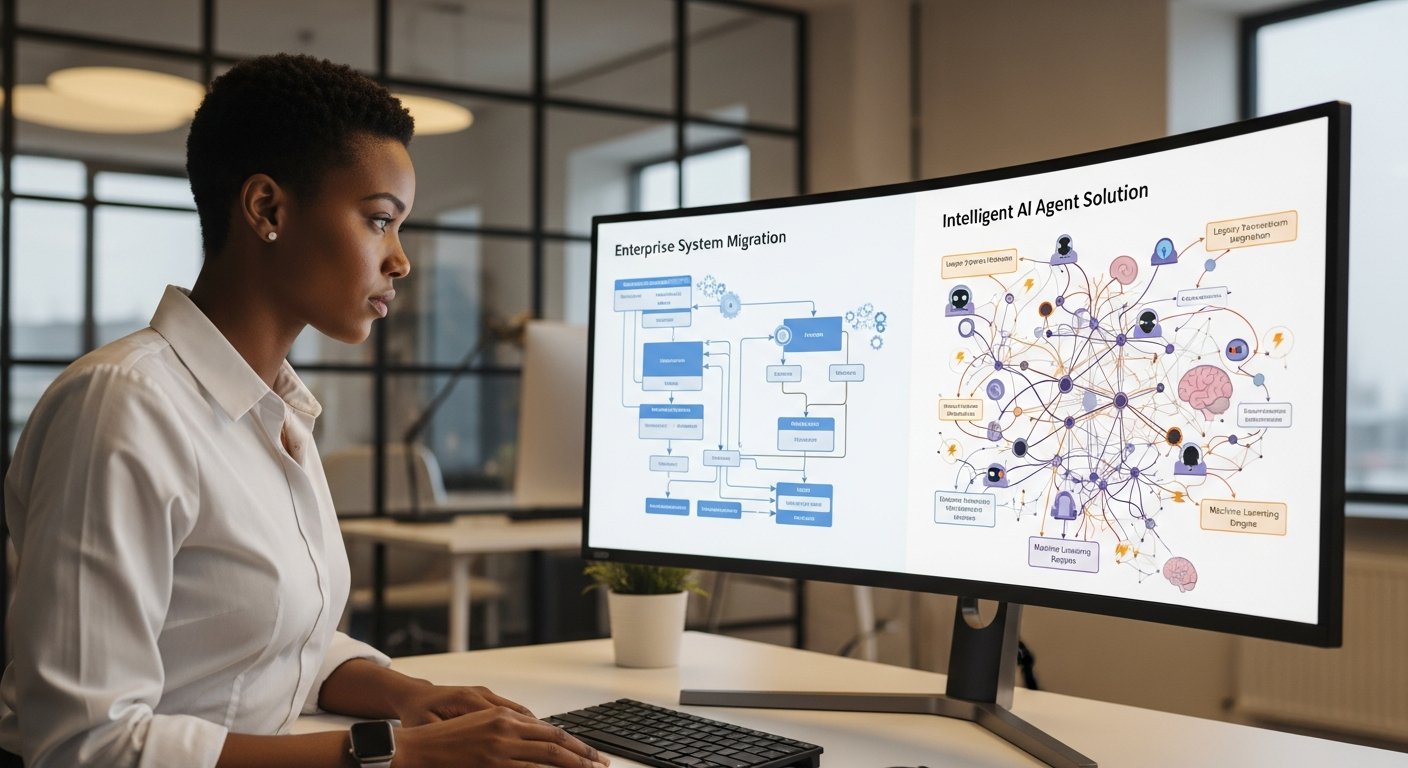
As a process owner staring down the barrel of an SAP migration, the question isn't if you'll automate, but how>. The world of enterprise automation has changed fast, bringing two main choices for making your move to S/4HANA or a new SAP environment easier: Robotic Process Automation (RPA) and AI Agent solutions. This article dives deep into <evaluating RPA vs AI agent solutions for SAP migration. We'll look at what they can do, what they cost, and where they work best. This should help you make a smart decision for your organization's future in 2026 and beyond.
Quick Verdict: RPA vs. AI Agents for SAP Migration
Honestly, for simple, high-volume, and predictable data transfers or UI tasks during an SAP migration, RPA often gets you up and running faster and cheaper. Think about moving thousands of customer records, generating basic reports, or checking data against a few clear rules. However, if you're dealing with tricky, changing processes, need smart data changes, want to spot oddities, or build systems that learn and improve themselves – especially with messy, unstructured data or situations needing human-like judgment – AI agents offer much more lasting value and flexibility. They really shine when a process needs to understand context and learn, transforming not just individual steps, but entire workflows.
>RPA vs. AI Agent Solutions for SAP: Feature Comparison Table<
Let's lay out a side-by-side comparison of how RPA and AI Agent solutions stack up against critical criteria for any SAP migration project. This table provides a quick reference for process owners to understand the fundamental differences.

| Feature/Criterion | RPA Solution (e.g., UiPath, Automation Anywhere) | >AI Agent Solution (e.g., specialized intelligent automation platforms, custom LLM-driven agents)< |
|---|---|---|
| Initial Setup Complexity | Generally lower for simple, rule-based tasks. It gets higher for complex UI paths. | Higher. You'll need data prep, model training, and integration with cognitive services. |
| Adaptability to Change (e.g., UI changes) | Low. Bots break easily with UI changes. They need re-scripting or lots of maintenance. | High. Agents can adapt to minor UI changes, understand context, and self-correct with retraining. |
| Data Transformation Capability | Limited to rule-based transformations. It struggles with unstructured data. | Advanced. Agents can understand, extract, normalize, and transform complex, unstructured, and semi-structured data. |
| Error Handling | Rule-based exception handling. Often requires human help for unexpected errors. | Intelligent. Agents can learn from errors, find root causes, and autonomously resolve or escalate with context. |
| Scalability | Scales by adding more bots. Efficiency is limited by process complexity. | Scales by processing power and model efficiency. It can handle exponential data growth and complex processes. |
| Cost-Effectiveness (Initial) | Lower initial investment. Quicker ROI for simple, high-volume tasks. | Higher initial investment due to development, training, and infrastructure. |
| Cost-Effectiveness (Long-term TCO) | Higher maintenance costs due to brittleness and re-scripting. | Potentially lower TCO due to adaptability, reduced human intervention, and continuous optimization. |
| Learning Capability | None. It executes predefined scripts only. | High. It learns from data, feedback, and interactions, improving performance over time. |
| Integration with SAP | Primarily UI-driven. Some offer API connectors but often rely on screen scraping. | Uses SAP APIs (BAPIs, RFCs, OData) for stable integration. Can also interact via UI. |
| Maintenance Effort | Significant, especially with frequent SAP updates or UI changes. | Lower for stable processes. Ongoing effort for model retraining and optimization. |
| Use Case Suitability | Repetitive, high-volume, rule-based tasks with structured data. | Complex, cognitive, dynamic processes involving unstructured data, decision-making, and optimization. |
>Deep Dive: Robotic Process Automation (RPA) for SAP Migration<
Robotic Process Automation, or RPA, has been a workhorse in enterprise automation for over a decade. When it comes to SAP migration, RPA's strength lies in its ability to mimic human interactions with existing SAP GUIs (Graphical User Interfaces) or web interfaces. It executes predefined, rule-based tasks with speed and accuracy. It's essentially a digital assistant that never sleeps, never makes typos, and never complains about repetitive work.
Strengths of RPA for SAP Migration:
- Structured Data Entry and Validation:> RPA excels at taking structured data from legacy systems (e.g., Excel, CSV, or even old databases) and accurately inputting it into new SAP S/4HANA fields. This is invaluable for migrating master data like customer records, vendor details, or material masters where the data format is largely consistent.<
- High-Volume, Repetitive Tasks: If you have thousands of identical transactions to process – say, creating sales orders from a queue of emails or updating GL accounts based on a specific rule set – RPA can handle this volume far quicker than any human team.
- UI Automation and Screen Scraping: For legacy SAP ECC systems or even older bespoke applications that lack robust APIs, RPA can interact directly with the user interface. It reads data from screens and inputs it into other systems. This is particularly useful for extracting historical data from systems that are difficult to integrate otherwise.
- Faster Time-to-Value for Simple Processes: For straightforward migration tasks, RPA bots can be developed and deployed relatively quickly. They offer a rapid return on investment by freeing up human resources almost immediately.
- Audit Trail Generation: Every action an RPA bot takes can be logged. This provides a detailed audit trail of data migration activities, which is critical for compliance and reconciliation during an SAP project.
Weaknesses of RPA for SAP Migration:
- Brittleness to UI Changes: This is RPA's Achilles' heel. Any change in the SAP UI – a button moving, a field name changing, or a new pop-up – can break an RPA script. This requires immediate and often manual re-scripting. During a dynamic SAP migration, where configurations and UIs might evolve, this can become a significant maintenance burden.
- Limited Cognitive Ability: RPA is inherently non-cognitive. It can't understand context, make decisions based on ambiguity, or handle unstructured data (like free-text comments in a legacy system) without explicit, rigid rules. It's truly a "do as I'm told" solution.
- Poor Handling of Unstructured Data: Trying to migrate complex contracts, email correspondence, or scanned invoices with RPA is a non-starter without pre-processing by other tools. RPA cannot interpret the meaning or extract relevant information from such data.
- Scalability Challenges for Complex Processes: While individual bots scale, managing a large fleet of complex RPA bots, each with intricate dependencies and potential failure points, can become an operational nightmare.
- "Lift and Shift" Mentality:> RPA tends to automate existing processes as they are, rather than optimizing them. For an SAP migration, which is an opportunity for business process re-engineering, this can perpetuate inefficiencies rather than eliminate them.<
Ideal Scenarios and Business Processes for RPA in SAP Migration:
I've seen RPA shine in specific, well-defined SAP migration contexts. Think of tasks like:
- Bulk Upload of Customer/Vendor Master Data: From a clean, structured CSV file into S/4HANA via standard transactions (e.g., using transaction LSMW or an equivalent Fiori app).
- GL Account Creation/Updates:> Automating the setup or modification of general ledger accounts in a new SAP system based on a predefined chart of accounts.<
- Simple Transactional Data Entry: Migrating historical purchase orders, sales orders, or invoices where the data structure is highly consistent.
- Report Generation and Extraction: Automatically logging into legacy SAP ECC, running specific reports, extracting data, and saving it to a shared drive for further processing.
- Initial User Provisioning: Setting up new user accounts in the SAP system with standard roles and profiles post-migration.
Deep Dive: AI Agent Solutions for SAP Migration
AI Agent solutions represent the next frontier in automation. They move beyond mere task execution to encompass understanding, learning, and autonomous decision-making. These agents use technologies like Natural Language Processing (NLP), Machine Learning (ML), computer vision, and Large Language Models (LLMs) to interact with SAP systems in a far more intelligent and adaptive manner. They're not just following a script; they're interpreting the situation and acting accordingly.

Strengths of AI Agent Solutions for SAP Migration:
- Understanding Context and Handling Unstructured Data: This is where AI agents truly differentiate themselves. They can read and comprehend free-text fields, email correspondence, scanned documents, and even voice commands, extracting relevant information for SAP inputs. Imagine migrating contracts or service agreements by having an AI agent understand clauses and populate corresponding fields in SAP CRM or S/4HANA.
- Dynamic Decision-Making and Process Optimization: Unlike RPA, AI agents can make informed decisions based on complex rules, historical data, and even real-time conditions. They can identify patterns, predict potential issues during migration, and suggest optimal data mapping or transformation rules. This moves beyond automation to true process intelligence.
- Self-Learning and Continuous Improvement: AI agents learn from every interaction and data point. As they process more migration data, they become more accurate, identify new patterns, and can even suggest improvements to the migration process itself. This adaptive capability significantly reduces long-term maintenance.
- Complex Data Transformation and Reconciliation: AI agents excel at transforming disparate data formats, enriching data with external sources, and reconciling discrepancies between legacy and target SAP systems. For instance, they can intelligently match product descriptions, customer names, or financial entries that don't have a perfect one-to-one mapping.
- Intelligent Document Processing (IDP) for SAP Inputs: For migrations involving vast amounts of paper-based or scanned documents (e.g., historical invoices, purchase orders, HR records), AI agents with IDP capabilities can automatically extract, classify, and validate data before feeding it into SAP. This drastically reduces manual effort and errors.
- Robust API-First Integration: While they can also interact via UI, AI agents are typically designed for deeper, more stable integration with SAP using standard APIs (BAPIs, OData, RFCs). This ensures resilience against UI changes and higher data integrity.
Weaknesses of AI Agent Solutions for SAP Migration:
- Higher Initial Investment: Developing, training, and deploying AI agents requires significant upfront investment in technology, skilled personnel (data scientists, AI engineers), and infrastructure.
- Longer Training Periods: AI models need substantial, high-quality data to learn effectively. This training phase can extend the initial deployment timeline, although the long-term benefits usually outweigh this.
- Explainability Challenges: Understanding "why" an AI agent made a particular decision can sometimes be difficult (the "black box" problem). This can be a concern for audit and compliance in SAP environments.
- Data Quality Dependence: The performance of an AI agent is heavily dependent on the quality and volume of training data. "Garbage in, garbage out" applies emphatically here.
- Ethical and Governance Considerations: Deploying AI in critical SAP migration processes necessitates careful consideration of data privacy, bias, and responsible AI practices.
Ideal Scenarios and Business Processes for AI Agents in SAP Migration:
From my perspective, AI agents are game-changers for these types of complex SAP migration challenges:
- Reconciling Complex Financial Reports: During an ECC to S/4HANA conversion, an AI agent can analyze and reconcile discrepancies in GL accounts, profit centers, or cost centers across different reporting structures. It identifies root causes and proposes adjustments.
- Intelligent Master Data Cleansing and Harmonization: Beyond simple de-duplication, an AI agent can identify semantic duplicates, standardize free-text fields (e.g., product descriptions), and enrich customer data by cross-referencing external sources.
- Automating Test Script Generation and Execution: An AI agent can analyze existing legacy system usage patterns, generate comprehensive test scripts for the new S/4HANA system, and even execute them, adapting to minor UI changes during testing cycles.
- Migrating Unstructured Content: Moving legacy documents (contracts, emails, support tickets) into SAP Document Management Systems (DMS) or S/4HANA attachments. It intelligently classifies and links them to relevant business objects.
- Automating Complex Cutover Activities: Orchestrating a sequence of migration tasks, monitoring their progress, and autonomously resolving minor issues or escalating complex ones based on real-time data and learned patterns.
- Predictive Anomaly Detection: During data loads, an AI agent can monitor for unusual data patterns or errors that might indicate deeper issues. This prevents corrupted data from entering the new SAP system.
Cost Analysis: RPA vs. AI Agents for SAP Migration Projects
Understanding the Total Cost of Ownership (TCO) is paramount for process owners. It's not just about the license fee; it's about development, infrastructure, maintenance, and the opportunity cost of not automating or automating sub-optimally.
RPA Cost Breakdown:
- License Fees: Typically per bot (attended or unattended) or per process. Major vendors like UiPath, Automation Anywhere, and Blue Prism have varying models, often ranging from $5,000 to $15,000+ per bot annually.
- Development Costs: Lower for simple bots ($5k-$20k per bot) as they are often low-code/no-code. However, costs can escalate for complex, integration-heavy bots ($20k-$50k+).
- Infrastructure Costs: Bots require virtual machines or servers to run. This incurs cloud or on-premise infrastructure costs.
- Maintenance & Support: This is often a hidden cost. Due to UI brittleness, ongoing maintenance can be substantial, especially with frequent SAP updates. Expect 20-40% of development cost annually.
- Training: Basic RPA training for developers is relatively straightforward.
RPA TCO over 1, 3, and 5 years:
For a project migrating 10 simple master data objects, I've seen initial year costs around $50,000 - $150,000 (licenses, development, basic infra). Over 3 years, this could climb to $150,000 - $450,000, largely due to maintenance. Over 5 years, if the SAP system undergoes significant changes, you could be looking at $250,000 - $750,000, with a substantial portion being re-scripting and troubleshooting.
AI Agent Cost Breakdown:
- Platform/Service Fees: Can be subscription-based, usage-based (e.g., per transaction, per API call), or a combination. Costs vary wildly depending on the complexity of the AI services (e.g., advanced NLP, computer vision, custom ML models).
- Development Costs: Significantly higher initially ($50k - $200k+ per agent/solution) due to the need for data scientists, AI engineers, data preparation, model training, and integration with various cognitive services and SAP APIs.
- Infrastructure Costs: Can be substantial, especially for on-premise deployments requiring powerful GPUs for model training and inference. Cloud-based AI services can mitigate this but introduce ongoing consumption costs.
- Maintenance & Optimization: While less prone to breaking from UI changes, AI agents require ongoing monitoring, model retraining, and fine-tuning to maintain accuracy and adapt to evolving data patterns. This can be 15-30% of development cost annually.
- Data Preparation & Governance: A critical, often underestimated cost. Ensuring high-quality, labeled data for training is crucial and can be labor-intensive.
AI Agent TCO over 1, 3, and 5 years:
An AI agent solution for complex data reconciliation might cost $150,000 - $500,000+ in the first year (platform, development, initial training). Over 3 years, with ongoing optimization, this could be $300,000 - $1.2 million+. Over 5 years, as the agent learns and scales, the relative cost might decrease, but total spend could reach $500,000 - $2 million+, reflecting its deeper integration and cognitive capabilities. The ROI, however, often comes from significant process improvements and error reduction, not just task automation.
ROI Considerations:
RPA delivers quicker, more tangible ROI for simple task automation. AI agents, while having a longer payback period, offer a higher strategic ROI by enabling true process transformation, reducing error rates, improving data quality, and freeing up human talent for more strategic work. The long-term value of an AI agent often far surpasses the initial investment by completely re-imagining a process rather than just automating its existing flaws.
When evaluating RPA vs AI agent solutions for SAP migration, consider platforms that offer transparent, tiered pricing and robust support for both approaches.
Amazon — Check related books on Amazon
Real-World Use Cases: When to Choose Which for SAP Migration
Let's get practical. Here are specific SAP migration scenarios and my recommendation for which automation approach makes the most sense.
Scenario 1: Migrating Customer Master Data from Legacy CRM to S/4HANA
- Description: You have 50,000 customer records in an old, structured CRM database. The data fields map almost perfectly to S/4HANA customer master data fields. You need to extract, perform basic validation (e.g., ensure email format), and upload.
- Recommendation: RPA. This is a classic RPA use case. The data is structured, the process is repetitive, and the rules are clear. An RPA bot can quickly extract data from the legacy system (via database connectors or UI), perform simple transformations, and input it into S/4HANA using standard transactions or Fiori apps. It's fast, efficient, and cost-effective for this specific task.
Scenario 2: Reconciling Complex Financial Reports During an ECC to S/4HANA Conversion
- Description: Post-conversion, you need to reconcile historical financial reports (e.g., balance sheets, income statements) generated from legacy ECC with new reports from S/4HANA. This involves understanding different account structures, identifying semantic discrepancies in descriptions, and explaining variances.
- Recommendation: AI Agent. An AI agent is indispensable here. It can use NLP to understand varying account descriptions, apply machine learning models to identify patterns in discrepancies, and even suggest journal entries or reclassification rules. It goes beyond simple matching to interpret the financial context, providing intelligent reconciliation that RPA simply cannot achieve.
Scenario 3: Automating Test Script Generation for SAP Regression Testing
- Description: Before go-live, you need to conduct extensive regression testing of critical business processes in S/4HANA. Manually creating thousands of test scripts is time-consuming and error-prone.
- Recommendation: AI Agent. An AI agent can analyze historical transaction data from your legacy system, understand typical user interaction patterns, and automatically generate robust, comprehensive test scripts for your S/4HANA environment. It can even prioritize test cases based on business criticality and past error rates. This capability significantly accelerates the testing phase and improves test coverage.
Scenario 4: Bulk Upload of Simple Vendor Invoices (Scanned PDFs)
- Description: You have a backlog of 10,000 scanned vendor invoices (PDFs) that need to be processed and posted in S/4HANA. The data on these invoices (vendor name, invoice number, amount, line items) needs to be extracted and accurately entered.
- Recommendation: AI Agent (with IDP capabilities). While RPA could theoretically interact with an OCR tool, an integrated AI agent with Intelligent Document Processing (IDP) is far superior. It can automatically classify the invoice, extract relevant fields (even from varying layouts), validate the data against master data in SAP, and then post the invoice, handling exceptions intelligently. RPA would struggle immensely with the variability of invoice layouts and the cognitive task of data extraction.
Scenario 5: Migrating HR Employee Data from an On-Premise System to SuccessFactors
- Description: You're moving employee master data, including personal details, employment history, and compensation, from an aging on-premise HR system to SAP SuccessFactors. Some data fields require complex transformations, and there might be inconsistencies in data formats.
- Recommendation: Hybrid Approach (RPA + AI Agent). For straightforward, structured data fields, RPA can handle bulk extraction and initial loading into staging tables. However, for identifying and resolving inconsistencies (e.g., different date formats, varying job titles needing standardization, missing mandatory fields), and for complex data transformations, an AI agent would be invaluable. The AI agent could analyze the extracted data, flag anomalies, suggest corrections, and ensure data quality before final upload to SuccessFactors.
I've found that for deep insights into specific automation solutions for SAP migrations, examining real-world case studies from leading vendors is incredibly helpful.
Amazon — Check related books on Amazon
Final Recommendation by SAP Migration Project Type
As a process owner, your primary goal is a smooth, efficient, and compliant SAP migration that delivers measurable business value. The choice between RPA and AI agents isn't one-size-fits-all; it depends heavily on the nature of your migration and the complexity of your processes.
- Greenfield Implementations (New SAP System, New Processes):
For Greenfield projects, where you're implementing S/4HANA from scratch and have the opportunity to design new, optimized processes, AI agents offer superior long-term value. They can help define and automate intelligent workflows from day one, handle complex data transformations during initial data loads, and continuously learn to optimize post-go-live operations. While initial data entry might use some RPA, the strategic advantage lies with AI agents for building an intelligent enterprise. Focus on using AI for process mining, intelligent data ingestion, and predictive analytics within your new SAP landscape.
- Brownfield Conversions (Existing SAP ECC to S/4HANA):
>Brownfield conversions present a mixed bag. For tasks involving direct replication of existing, well-defined, and structured processes (e.g., migrating standard master data, simple transactional data), RPA can provide quick wins and free up resources. However, for significant process re-engineering, data cleansing, reconciliation of historical data, and intelligent testing, AI agents are critical. I recommend a hybrid strategy: use RPA for the low-hanging fruit and high-volume, repetitive tasks. Invest in AI agents for the complex, cognitive challenges that will truly transform your business processes and ensure data quality during the transition.<
- Selective Data Transition (Moving Specific Data/Processes to S/4HANA):
This type of migration often involves a high degree of complexity and precision. AI agents are generally the stronger choice here. Their ability to understand context, intelligently transform and harmonize data, and handle exceptions autonomously is invaluable when you're selectively moving subsets of data and processes. RPA might be used for very specific, isolated data transfers, but the overarching intelligence required for selective data transition strongly favors AI agents. They can help ensure that only clean, relevant, and well-mapped data makes it into your new S/4HANA environment.
Ultimately, when evaluating RPA vs AI agent solutions for SAP migration, consider the strategic implications. RPA is excellent for automating tasks; AI agents are designed to automate and optimize entire processes. Your SAP migration isn't just a technical upgrade; it's a business transformation opportunity. Choose the solution that best aligns with your long-term vision for an intelligent, agile enterprise.
For more detailed information on how these solutions fit into a broader automation strategy, especially within an SAP context, I encourage you to explore our pillar page on SAP AI Automation.
FAQ: Evaluating Automation for SAP Migration
What's the biggest risk of using RPA for SAP migration?
The biggest risk is how easily RPA bots break when the SAP user interface (UI) changes. During an SAP migration, especially a brownfield conversion, the UI of the target system (S/4HANA Fiori apps or SAP GUI) might undergo several changes or updates. Each change can break an RPA script, leading to significant re-scripting effort, delays, and increased maintenance costs. This fragility can undermine the perceived efficiency of RPA.
Can AI agents handle unstructured data during SAP migration?
Yes, absolutely. This is one of the core strengths of AI agents. Using Natural Language Processing (NLP), Machine Learning (ML), and Computer Vision (for Intelligent Document Processing), AI agents can understand, extract, classify, and transform information from various unstructured sources like emails, PDF documents (scanned or native), contracts, free-text fields in legacy systems, and even voice recordings. This capability is critical for migrating complex business documents and historical context into SAP.
How do I measure the ROI of AI agents in SAP?
Measuring ROI for AI agents involves more than just headcount reduction. Key metrics include: (1) Reduced Error Rates: Fewer data quality issues, leading to less rework and reconciliation. (2) Faster Process Cycle Times: Significant acceleration of complex migration steps. (3) Improved Data Quality: Quantify the reduction in bad data entering the new SAP system. (4) Enhanced Decision-Making: The value derived from intelligent insights and proactive issue resolution. (5) Scalability: The ability to handle larger volumes and more complex scenarios without proportional increases in human effort. (6) Compliance & Auditability: Improved adherence to regulations and clearer audit trails.
Is custom coding required for AI agents in SAP?
Often, yes, to some extent. While many AI agent platforms offer low-code/no-code interfaces for simpler tasks or pre-built models, integrating deeply with SAP APIs (BAPIs, RFCs, OData), fine-tuning models for specific business contexts, and handling complex data transformations usually requires custom development by skilled data scientists and AI engineers. The complexity depends heavily on the specific use case and the richness of the platform's out-of-the-box SAP connectors and AI capabilities.
What's the learning curve for business users with these solutions?
For RPA, the learning curve for business users is generally low, especially for interacting with attended bots. For process owners, understanding how to identify suitable processes for RPA is key. For AI agents, the learning curve for business users can be higher, particularly in understanding how to interact with intelligent systems, interpret their outputs, and provide feedback for continuous learning. However, the goal is for AI agents to make processes simpler and more intuitive for end-users, reducing their cognitive load rather than increasing it. Training often focuses on collaboration with the agent rather than direct programming.
How do these solutions integrate with SAP's security protocols?
Both RPA and AI agent solutions must adhere strictly to SAP's robust security protocols. RPA bots typically interact with SAP using dedicated service accounts with specific, restricted roles and authorizations, mimicking a human user login. AI agents, especially those using APIs, integrate more deeply and securely. They utilize standard SAP authentication mechanisms (e.g., OAuth, SSO, certificate-based authentication) and can be configured to comply with SAP's authorization objects and access control lists. It's crucial that any automation solution integrates via secure channels, encrypts sensitive data in transit and at rest, and maintains a comprehensive audit log of all actions within the SAP environment.