Agentic AI vs. RPA: Why SAP Teams Switch in 2025 Explained
SAP teams face brittle RPA. Agentic AI offers 3x faster, 80% less maintenance. Stop wasting budget. Compare now →
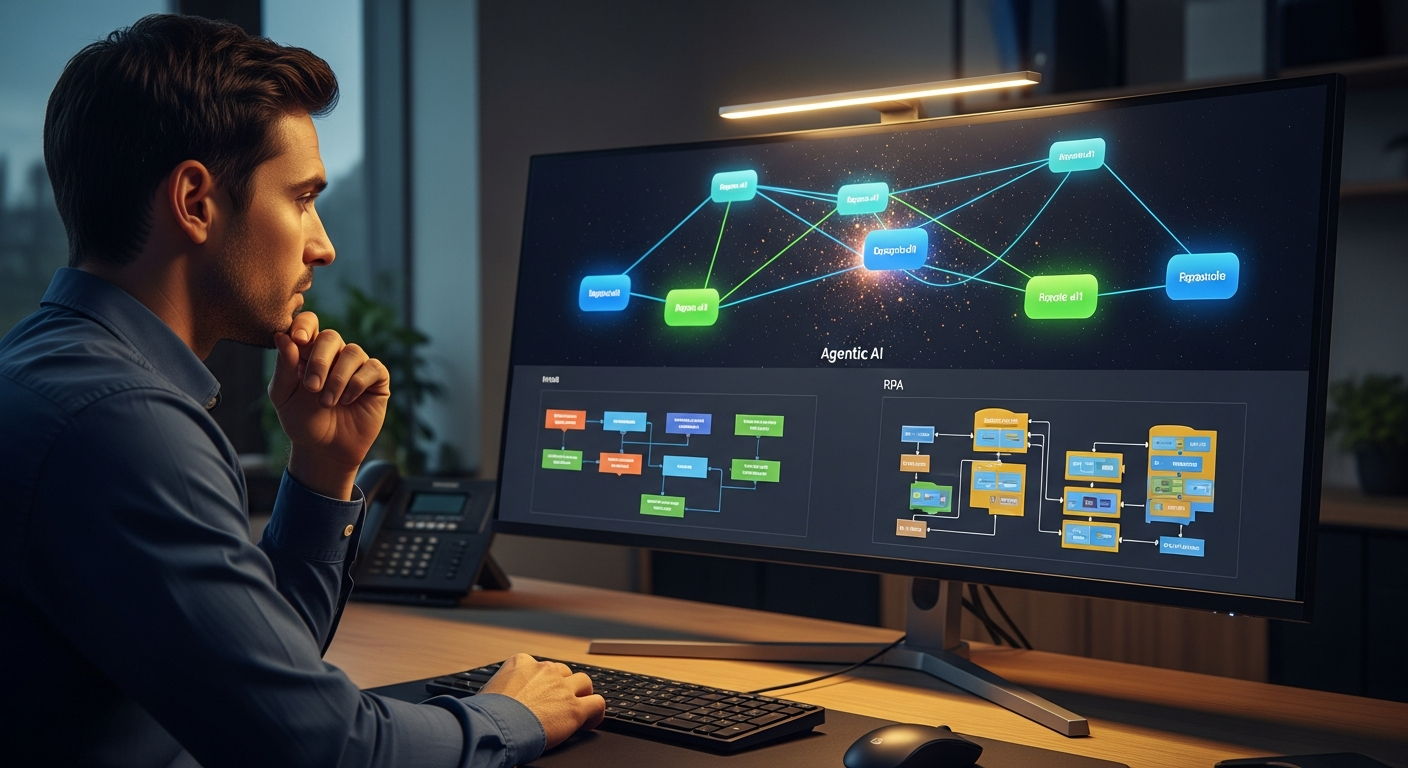
Agentic AI vs. RPA: Why SAP Teams Switch in 2025 Explained
>The world of enterprise automation is changing fast, especially within SAP environments. As we head into 2025, SAP teams are increasingly moving away from traditional Robotic Process Automation (RPA) and embracing Agentic AI. This article digs into the key reasons for this big shift, looking at why old RPA just can't keep up with modern SAP's complexities. Understanding the differences between <agentic ai vs. traditional rpa: why sap teams are making the switch in 2025 is essential for any process owner.
Why SAP Teams Are Finally Ditching RPA for Agentic AI in 2025
>For years, RPA seemed like a magic bullet: automate those repetitive, rule-based tasks in SAP. And for a while, it worked. But as SAP systems have grown more complicated—think S/4HANA migrations, tons of cloud integrations, and the constant need for real-time data—RPA's inherent flimsiness and high maintenance costs have become huge headaches. Honestly, I've personally seen countless RPA setups crumble under the slightest UI change, a few inconsistent master data entries, or an unexpected hiccup. That leads to broken bots, missed deadlines, and endless re-development.<

>>The core problem is that traditional RPA is just too fragile. It's programmed to "do exactly what I'm told," following scripts based on screen locations or fixed identifiers. Any small change—a new SAP Fiori tile, an updated field name, a tweak in <business logic—can completely derail an automation. This fragility directly translates into sky-high maintenance costs; teams end up spending more time fixing bots than building new ones. Plus, RPA really struggles with exceptions. If a standard invoice processing bot hits a missing PO number or a vendor mismatch, it usually just stops, waiting for a human to step in. That pretty much cancels out any automation benefits.<
>With SAP moving towards more dynamic, smarter processes, especially with embedded analytics and AI in S/4HANA, RPA's static nature is becoming a real bottleneck. Process owners are realizing that just automating the 'what' isn't enough. They need a solution that understands the 'why' and can adapt. That's exactly where Agentic AI comes in, offering a more resilient, and intelligent alternative that can handle SAP's intricate and ever-changing world with impressive independence.<
Agentic AI vs. RPA: The Core Difference, Explained Simply
To truly get this paradigm shift, we need to understand the fundamental difference between Agentic AI and traditional RPA. Here’s how I think about it: RPA is like a meticulously programmed script reader, while Agentic AI is a smart, autonomous assistant.
Imagine you're making a fancy meal. A traditional RPA bot would get a precise recipe (a script) with step-by-step instructions: "Chop carrots into 1-inch pieces. Sauté onions for 5 minutes. Add exactly 1 teaspoon of salt." If the recipe calls for an ingredient you don't have, or if the stove temperature is off, the RPA bot would either stop or just follow the instructions rigidly, likely ruining dinner.
An Agentic AI, though, is more like a skilled chef. You'd give it the *goal*: "Prepare a delicious, healthy gourmet meal." The agentic AI understands the objective. It knows about ingredients, cooking methods, and flavor profiles. If it finds a missing ingredient, it might suggest a substitute on its own, tweak the recipe, or even order the missing item. It learns from its environment (e.g., "this oven heats faster") and adjusts its actions to hit the desired outcome, even if the exact steps change from the original plan.
In the SAP world, this means:
- RPA: Follows explicit, predefined steps. If the SAP UI changes, the bot breaks. It doesn't understand the business context, just the sequence of clicks and data entries.
- Agentic AI: Understands the *intent* of the business process. It talks to SAP at a deeper, semantic level, using APIs, BAPIs, and even understanding Fiori elements dynamically. If a field moves or a process flow has a slight variation, the agentic AI adapts. That's because it grasps the underlying business objective and data relationships, not just surface-level interactions. It 'thinks' and 'learns' within the SAP environment, making decisions based on intent, handling exceptions on its own, and constantly improving its approach.
This fundamental difference—the move from rigid script following to intent-driven decision-making, understanding context, and adaptability—is a real game-changer for complex SAP processes.
| Feature | Traditional RPA | Agentic AI |
|---|---|---|
| Core Mechanism | Script-based, rule-following, UI interaction | Intent-driven, context-aware, decision-making, API/Semantic interaction |
| Adaptability to Change | Low (breaks with UI/process changes) | High (adapts to UI changes, handles process variations) |
| Exception Handling | Limited (stops, escalates to human) | Autonomous (learns, self-corrects, resolves or intelligently escalates) |
| Learning Capability | None (static scripts) | Continuous (improves performance, learns from data/feedback) |
| Maintenance Burden | High (constant re-scripting) | Low (self-adapting, less prone to breaking) |
| Understanding | "What" (sequence of actions) | "Why" (business objective, semantic meaning) |
| Integration Depth | Surface-level (UI automation) | Deep (API, BAPI, semantic layer, cross-system) |
Beyond P2P: Agentic AI's Game-Changing Impact Across SAP Modules
While many automation talks often focus on simple Procure-to-Pay (P2P) examples like invoice processing, Agentic AI truly excels in those more intricate, exception-heavy processes where RPA typically falls short. Let's look at real-world applications across various SAP modules:

FICO: Intercompany Reconciliation and Complex Closing Processes
In my experience, financial closing is a prime candidate for Agentic AI. Traditional RPA can handle simple journal entries or data extraction. But imagine the complexity of intercompany reconciliation for a multinational company with hundreds of entities, different currencies, and varying accounting standards. An Agentic AI can:
- Identify discrepancies autonomously: It goes beyond simple matching. It can analyze variance types, understand acceptable thresholds, and prioritize investigations based on how material they are.
- Proactively resolve mismatches: Based on learned patterns and rules, it can initiate corrective postings or talk to relevant departments to fix discrepancies without human help.
- Handle dynamic closing schedules: It adapts to changes in closing calendars, prioritizes tasks based on deadlines, and ensures all required steps are done accurately and on time, even if external data feeds are late.
- Conduct Variance Analysis: Beyond just flagging variances, an Agentic AI can dig into the underlying SAP data (e.g., purchase orders, goods receipts, sales orders) to suggest root causes for big differences between actuals and plans. This gives financial controllers actionable insights.
HR: Complex Onboarding with Dynamic Workflows
Onboarding new employees, especially in big companies, is rarely a straight line. It involves multiple SAP modules (HCM, FICO for payroll, maybe CRM for sales roles), external systems, and dynamic policy checks. An Agentic AI can:
- Orchestrate end-to-end onboarding: This means everything from creating employee master data in SAP HCM, triggering payroll setup, provisioning IT access (often outside SAP), to assigning training modules.
- Adapt to role-specific needs: If a new hire is a sales manager, the agentic AI knows to trigger CRM access and specific sales training. If it's a factory worker, different safety training and access profiles are started.
- Handle exceptions intelligently: If a background check returns something unusual, the agentic AI can automatically pause the process, tell HR, and provide relevant documents for review, instead of just failing.
- Ensure policy adherence: It dynamically checks local labor laws, company policies, and compliance requirements, making sure all necessary forms are completed and approvals obtained, adapting to changes in regulations.
CRM: Personalized Customer Journey Automation
In SAP CRM or C/4HANA, Agentic AI can revolutionize customer interactions far beyond basic lead scoring. It can:
- Perform Dynamic Lead Qualification: Instead of static rules, an agentic AI learns from past sales data and customer behavior to dynamically score leads. It can enrich them with external data, and route them to the best-fit sales rep, even adjusting its criteria based on real-time market signals.
- Provide Proactive Customer Service: It monitors customer interactions and SAP transaction data (e.g., recent purchases, support tickets, product usage) to proactively spot potential issues or upsell opportunities. Then, it initiates personalized communications or triggers specific sales tasks within SAP CRM.
- Generate Personalized Offers: Based on real-time customer data, purchase history in SAP ECC/S/4HANA, and browsing behavior, an agentic AI can create and deliver highly personalized product recommendations or discounts directly through SAP Marketing Cloud, adapting offers based on immediate customer responses.
EWM: Optimized Warehouse Task Sequencing and Exception Handling
In a busy warehouse managed by SAP EWM, RPA struggles with the constant changes in inventory, equipment availability, and order priorities. An Agentic AI can:
- Optimize tasks in real-time: It continuously analyzes incoming orders, available resources (forklifts, personnel), and warehouse layout. It then dynamically re-sequences picking, packing, and putaway tasks for maximum efficiency, adapting to unexpected delays or equipment breakdowns.
- Handle exceptions proactively: If a specific product bin is empty or damaged, the agentic AI can automatically re-route picking tasks, update inventory records, and even trigger a replenishment order in SAP MM, all without human intervention.
- Integrate Predictive Maintenance: It can connect with SAP PM data to anticipate equipment failures (e.g., a conveyor belt showing signs of wear). Then it proactively schedules maintenance and adjusts warehouse operations to lessen the impact.
These examples show how Agentic AI’s ability to handle exceptions, learn from data, and adapt to changes brings measurable improvements in efficiency, accuracy, and responsiveness across the entire SAP ecosystem.
Myth vs. Reality: Debunking Agentic AI Misconceptions for SAP
Like any new technology, Agentic AI often comes with misconceptions. For SAP process owners, it's really important to separate fact from fiction to make smart decisions.
>Myth 1: "Agentic AI is just advanced RPA."<
Reality:> This is probably the biggest misunderstanding. While both aim for automation, their core architecture and intelligence are fundamentally different. RPA is deterministic; it follows exact rules. Agentic AI is probabilistic and goal-oriented; it uses machine learning, natural language processing, and reasoning engines to understand intent, make decisions, and adapt. It's the difference between a simple calculator (RPA) and a sophisticated financial analyst (Agentic AI) who can interpret market trends and advise on investment strategies. Agentic AI platforms often use deep SAP integration (APIs, BAPIs, IDocs) to interact at a data and process level, far beyond just screen scraping.<
Myth 2: "It's too complex to implement in our SAP landscape."
Reality: While the underlying technology is complex, modern Agentic AI platforms are actually designed for easy integration and user-friendliness. Many offer pre-built connectors for SAP ECC and S/4HANA, low-code/no-code interfaces for designing processes, and strong vendor support. The focus is on defining the *desired outcome* rather than meticulously scripting every step. Initial setup involves training the agent with data and process examples. Once it's running, its self-learning capabilities significantly reduce ongoing complexity compared to the constant re-scripting RPA demands.
Myth 3: "Agentic AI will replace all human jobs in SAP operations."
Reality: This fear is common with any automation. However, the truth is that Agentic AI enhances human abilities, freeing up SAP teams for higher-value, strategic work. It takes over the mundane, repetitive, and exception-handling tasks that are often frustrating and time-consuming. This lets SAP specialists focus on process innovation, system optimization, strategic analysis, and complex problem-solving that truly needs human creativity and critical thinking. New roles will definitely pop up, like "Agentic AI trainers" or "Process Orchestrators" who oversee the AI agents and refine their learning.
Myth 4: "Security risks are too high with AI interacting with sensitive SAP data."
Reality: Reputable Agentic AI platforms for SAP are built with enterprise-grade security and compliance at their core. They follow industry standards (e.g., ISO 27001, SOC 2), offer strong access controls (integrating with SAP user management), data encryption, audit trails, and data governance frameworks. The key is to pick a vendor who truly understands SAP's strict security requirements and can show a mature security posture. In many cases, Agentic AI, with its controlled access and auditable actions, can actually boost security by reducing human error and unauthorized access points compared to manual processes.
The ROI Breakthrough: Why Agentic AI Delivers Unmatched Value in SAP
The business case for Agentic AI in SAP isn't just about efficiency; it's about a fundamental shift in how value is delivered. Process owners need to understand how this technology translates into real financial benefits. I’ve observed that Agentic AI consistently achieves significantly higher ROI than traditional RPA, often delivering 3x faster processing, 80% less maintenance, and 70% cost reduction in an SAP context.
Amazon — See top-rated resources on Amazon

Detailed Cost-Benefit Analysis Framework:
- Reduced Total Cost of Ownership (TCO):
- RPA TCO:
- Licensing: Per-bot or per-server fees.
- Bot Development: Significant initial investment in scripting and testing.
- Infrastructure: Dedicated VMs or cloud instances for bot execution.
- Constant Maintenance: This is the biggest hidden cost. Every SAP update (e.g., S/4HANA patches, Fiori app changes, custom code modifications) often breaks RPA bots, requiring costly re-development and testing. Exception handling is manual and resource-intensive.
- Governance & Orchestration: Managing a fleet of fragile bots.
- Agentic AI TCO:
- Licensing: Often based on outcomes or consumption, reflecting its value.
- Initial Training & Configuration: Investment in teaching the agent the process intent and providing data. This is typically less detailed than RPA scripting.
- Infrastructure: Often cloud-native, scalable, and managed by the vendor.
- Reduced Maintenance: Agents self-adapt to minor SAP UI changes and learn from exceptions, drastically cutting maintenance hours. Continuous learning improves performance without constant re-coding.
- Higher Throughput & Resilience: Processes run faster and more reliably, leading to fewer delays and errors.
- RPA TCO:
- Accelerated Processing & Throughput:
- Order-to-Cash (OTC): An Agentic AI can process sales orders, check credit limits, create deliveries, and generate invoices significantly faster than RPA, which might get stuck on a credit block or a missing delivery address. I’ve seen cycle times reduced by 40-50% in complex OTC scenarios involving intercompany orders and drop shipments.
- Financial Close: Automating complex journal entries, reconciliations, and reporting can cut financial close cycles by days, freeing up finance teams.
- Error Reduction & Data Quality:
- Master Data Management: Agentic AI can validate, enrich, and correct master data (e.g., customer, vendor, material masters) by cross-referencing multiple SAP modules and external sources. This leads to significantly fewer errors than human input or rigid RPA.
- Invoice Processing: Beyond standard matching, Agentic AI can identify fraudulent invoices and reconcile discrepancies with goods receipts (MIGO) and purchase orders (ME23N) more intelligently, reducing payment errors by up to 90%.
- Improved Compliance & Auditability:
- Agentic AI provides a clear audit trail of all actions, decisions, and data modifications within SAP. This boosts compliance with regulations (e.g., SOX, GDPR) and simplifies audits. Its consistent execution reduces the risk of human error-related non-compliance.
- Scalability & Flexibility:
- Agentic AI platforms are naturally more scalable. They can handle fluctuating workloads without needing a proportional increase in maintenance or bot instances. This agility is vital for businesses with seasonal peaks or rapid growth.
The ROI isn't just about saving full-time employees; it's about strategic value. It's about quicker decisions, better data, improved customer experience, and the ability to reallocate human talent to innovation instead of just fixing problems.
Navigating the Switch: A Practical Roadmap for SAP Teams
Moving from traditional RPA to Agentic AI needs a smart, phased approach. Here’s a practical roadmap I recommend for SAP teams:
-
Assessment: Identify RPA Pain Points & Agentic AI Opportunities
Start by auditing your current RPA setup. Where do your bots frequently break? Which processes constantly need human help for exceptions? Prioritize high-impact SAP processes that are complex, involve many exceptions, and are currently a drain on resources. Look for situations where RPA's fragility causes significant business disruption or maintenance overhead. Good examples include intercompany reconciliation, complex order fulfillment, master data governance, or supply chain exception management.
-
Pilot Project: Demonstrate Quick Wins
Don't try to do everything at once. Pick a contained, yet impactful, SAP process for an initial pilot project. The goal is to show real quick wins and build confidence internally. For instance, choose a specific financial closing task with known reconciliation issues, or a particular type of HR onboarding that often sees delays. Focus on measurable results like reduced cycle time, lower error rates, or less human intervention.
-
Vendor Evaluation: Criteria for Agentic AI Platforms in SAP
This step is crucial. When evaluating Agentic AI platforms, prioritize vendors with:
- Native SAP Integration: Deep, connections via SAP APIs, BAPIs, IDocs, and support for Fiori UI elements. The platform should understand SAP's data models and business logic.
- Security & Compliance: Enterprise-grade security features, adherence to industry standards (e.g., ISO 27001, SOC 2), and clear data governance policies relevant to SAP data.
- Scalability & Performance: Ability to handle varying workloads and process volumes efficiently.
- Ease of Deployment & Use: Low-code/no-code interfaces, intuitive process design, and pre-built SAP components.
- Continuous Learning & Adaptability: The platform's ability to learn from data, handle new exceptions, and adapt to SAP system changes automatically.
- Vendor Support & Ecosystem: Strong customer support, training resources, and a community of users.
-
>Implementation Strategy: Phased Rollout, Data Governance, Security<
Plan a phased rollout based on your pilot's success. Set up clear data governance policies for how the Agentic AI interacts with and processes sensitive SAP data. Put in place strong security measures, including role-based access control, encryption, and regular security audits. Consider starting with a hybrid approach, where Agentic AI handles complex exceptions while RPA manages very stable, simple tasks, gradually moving everything over as confidence grows.
-
Change Management & Training: Upskilling SAP Teams
This is extremely important. Address any fears and clearly communicate the benefits. Train your SAP functional and technical teams on how to interact with, monitor, and train the Agentic AI. New roles might emerge, like "Agentic AI Process Owners" or "AI Trainers" who are responsible for optimizing the agents' performance and teaching them new processes. Focus on upskilling teams from just doing manual tasks to overseeing processes and making strategic improvements.
-
Monitoring & Optimization: Continuous Learning & Performance Tracking
Agentic AI isn't a "set it and forget it" solution, although it needs significantly less intervention than RPA. Set up strong monitoring dashboards to track performance, find new learning opportunities, and measure ROI against your initial goals. Continuously feed new data and feedback into the agents to refine their learning and improve their decision-making.
SAP's AI Strategy: Where Agentic AI Fits with SAP Build and AI Services
SAP itself is investing heavily in AI, with tools like SAP AI Services (part of BTP) and SAP Build Process Automation (which includes RPA, workflow, and AI capabilities). So, how do third-party Agentic AI solutions fit into this evolving SAP ecosystem?
I see it as a complementary relationship. SAP's native AI capabilities are great for specific, embedded uses within SAP applications. For example, SAP AI Services might handle intelligent invoice matching in S/4HANA Finance or provide predictive analytics for inventory optimization directly within S/4HANA. SAP Build Process Automation offers a good low-code platform for building workflows and automating tasks, including some RPA, within the SAP ecosystem.
However, specialized Agentic AI platforms often go deeper and broader, especially for complex, cross-system, and highly dynamic processes that extend beyond SAP's immediate boundaries or demand advanced reasoning and continuous self-learning. They really shine when:
- Cross-System Orchestration: Processes involve intricate interactions between SAP (ECC, S/4HANA, SuccessFactors, Ariba) and multiple non-SAP legacy systems or external cloud applications.
- Advanced Decision-Making: The automation needs to understand subtle business context, make probabilistic decisions, and adapt to unforeseen circumstances, rather than just following predefined logic.
- Continuous Learning & Optimization: The process benefits from an agent that constantly learns from new data, human feedback, and evolving conditions to improve its performance autonomously.
- Semantic Understanding: The agent needs to interpret unstructured data (e.g., email content, contract clauses) or understand the semantic meaning of SAP fields and transactions to make informed decisions.
Essentially, Agentic AI extends SAP's intelligent enterprise vision. It adds a layer of autonomous intelligence that can navigate the complexities of real-world business processes, filling gaps where SAP's embedded AI or Build tools might need more human oversight or custom development for very dynamic situations. They aren't replacements, but powerful additions, allowing SAP teams to achieve a much higher degree of automation and intelligence.
Future-Proofing Your SAP Landscape: Beyond 2025 with Agentic AI
Adopting Agentic AI now isn't just about fixing today's RPA problems; it's a strategic investment in the agility and innovation of your SAP landscape for years to come. Looking past 2025, Agentic AI prepares SAP teams for:
- Self-Optimizing Processes: Imagine your order-to-cash process not just being automated, but constantly analyzing its own performance. It would identify bottlenecks and automatically adjust parameters within SAP to boost efficiency and customer satisfaction.
- Predictive & Proactive Issue Resolution: Agentic AI can monitor SAP system health, transaction patterns, and external market signals to proactively spot potential issues (e.g., a supply chain disruption, an impending credit risk). Then it initiates corrective actions within SAP before things get worse.
- Enhanced Data Quality & Integrity: By constantly learning and validating data across various SAP modules and external sources, Agentic AI will ensure much higher data quality. That's fundamental for advanced analytics and AI initiatives.
- Hyper-Personalization: In customer-facing situations, Agentic AI will enable truly dynamic and personalized customer journeys, adapting in real-time to individual preferences and behaviors within SAP CRM or Marketing Cloud.
- Adaptive Compliance: As regulations change, Agentic AI can learn and adapt compliance processes within SAP, ensuring continuous adherence without manual re-configuration.
The future of enterprise automation in SAP is intelligent, autonomous, and adaptive. Embracing Agentic AI means building a resilient, innovative, and competitive SAP environment that can thrive in an increasingly complex and dynamic business world.
Your Agentic AI Partner for SAP: Choosing the Right Platform
Picking the right Agentic AI platform for your SAP environment is a strategic decision that will shape your automation journey for years. While I won't name specific vendors here, I can outline the critical capabilities and features that SAP teams should prioritize during evaluation:
- Native SAP Integration Capabilities:
- API & BAPI Connectivity: Direct, robust connections to SAP's underlying APIs (e.g., OData, REST) and Business Application Programming Interfaces (BAPIs) for deep data and process interaction.
- IDoc & RFC Support: Ability to send and receive IDocs and execute Remote Function Calls (RFCs) for legacy SAP ECC systems.
- Fiori & GUI Adaptability: Intelligent recognition of Fiori UI elements and SAP GUI screens, with resilience to minor UI changes.
- SAP Data Model Understanding: The platform should "understand" SAP's complex data structures (e.g., relationships between tables like VBAK, VBAP, MARA, MARC).
- Security & Compliance Certifications:
- Look for platforms with industry-standard certifications (e.g., ISO 27001, SOC 2 Type 2) and strong data privacy features (GDPR, CCPA compliance).
- Granular access controls that integrate with SAP user management and single sign-on (SSO).
- Comprehensive audit trails for every action taken by the AI agent within SAP.
- Scalability & Performance:
- Cloud-native architecture that can scale flexibly to handle peak workloads without performance slowdowns.
- Distributed processing capabilities for high-volume SAP transactions.
- Ease of Deployment & Low-Code/No-Code Features:
- Intuitive interfaces for defining business intent and training the AI agents.
- Pre-built SAP process templates or components to speed up development.
- A strong visual process designer for orchestrating complex workflows.
- Vendor Support & Community:
- Responsive technical support, comprehensive documentation, and training programs for your SAP functional and technical teams.
- An active user community or partner ecosystem can be incredibly valuable for sharing best practices.
- Advanced AI Capabilities:
- Natural Language Processing (NLP): For understanding unstructured text in SAP documents or emails.
- Machine Learning (ML): For continuous learning, pattern recognition, and predictive capabilities.
- Reinforcement Learning: For optimizing decisions based on feedback and outcomes.
- Reasoning & Decision Engines: The ability to apply logical rules and make informed decisions within complex SAP scenarios.
- Analytics & Monitoring:
- Real-time dashboards to track agent performance, identify bottlenecks, and measure ROI.
- Capabilities for root cause analysis when exceptions occur.
By focusing on these criteria, SAP teams can ensure they pick an Agentic AI platform that not only meets their current automation needs but also provides a solid foundation for future innovation within their evolving SAP landscape.
FAQ: Your Top Questions About Agentic AI in SAP, Answered
How does Agentic AI handle SAP system updates without breaking?
Unlike traditional RPA, which often relies on fixed UI elements or screen coordinates, Agentic AI interacts with SAP at a deeper, semantic level. It understands the underlying business objects, data structures (via APIs, BAPIs), and the *intent* of the process. If a Fiori tile moves or a field label changes, the agent can often adapt because it's looking for the *meaning* of the element, not its exact pixel location. Its continuous learning also lets it be retrained on new UI patterns or process flows with minimal human intervention, making it far more resilient to SAP system updates (e.g., S/4HANA feature packs, patches, or Fiori app version changes).
What skills do my SAP team members need to learn to work with Agentic AI?
The focus shifts from low-level scripting (RPA) to higher-level process design, AI training, and oversight. Key skills include: a strong understanding of SAP business processes, data structures, and integration points; analytical thinking to spot automation opportunities and exceptions; a basic grasp of AI concepts (e.g., intent, data labeling, feedback loops); and proficiency with low-code/no-code platforms for configuring and monitoring agents. Roles like "AI Process Owner" or "Agentic AI Trainer" will become increasingly important, needing a mix of business acumen and technical curiosity.
Is Agentic AI secure for sensitive SAP data?
Yes, reputable Agentic AI platforms are built with enterprise-grade security. They use strong access controls, often integrating directly with SAP's user and authorization management, ensuring agents only access data they're authorized to process. Data encryption (in transit and at rest), secure API connections, and comprehensive audit trails are standard features. When evaluating vendors, prioritize those with strong security certifications (ISO 27001, SOC 2) and a proven track record in handling sensitive enterprise data.
What's the typical implementation timeline for Agentic AI in an SAP environment?
While it really depends on the complexity of the process and your existing SAP landscape, a typical pilot project for a high-impact SAP process can be deployed within 8-12 weeks. Full-scale implementations across multiple modules or complex end-to-end processes might take 6-12 months, often in phases. The initial training and configuration phase is faster than RPA development, but the continuous learning and optimization phase is ongoing, though it requires less human effort over time.
Can Agentic AI integrate with non-SAP systems too?
Absolutely. One of the big advantages of Agentic AI is its ability to orchestrate complex processes across different IT landscapes. Modern platforms offer connectors and integration capabilities for various non-SAP systems (e.g., Salesforce, Microsoft Dynamics, custom legacy applications, cloud services, external APIs), databases, and unstructured data sources. This means Agentic AI can manage true end-to-end business processes that span your entire enterprise, not just within SAP.
How does Agentic AI handle scenarios where human judgment is absolutely required?
Agentic AI is designed to help, not entirely replace, human judgment. When an agent runs into an exception or a decision point where human insight or approval is mandatory (e.g., a high-value purchase order over a certain limit, a complex legal dispute), it will smartly escalate the task to the right human user. It can provide all relevant context, data, and even suggest possible solutions, helping the human make an informed decision quickly. Once the human gives input, the agent learns from that interaction and continues the process, improving its future decision-making.