Gemini vs GPT-4o Price Comparison: Strategic AI for Business
Compare Gemini 1.5 Pro & GPT-4o costs, features, and use cases for optimal business AI investment.
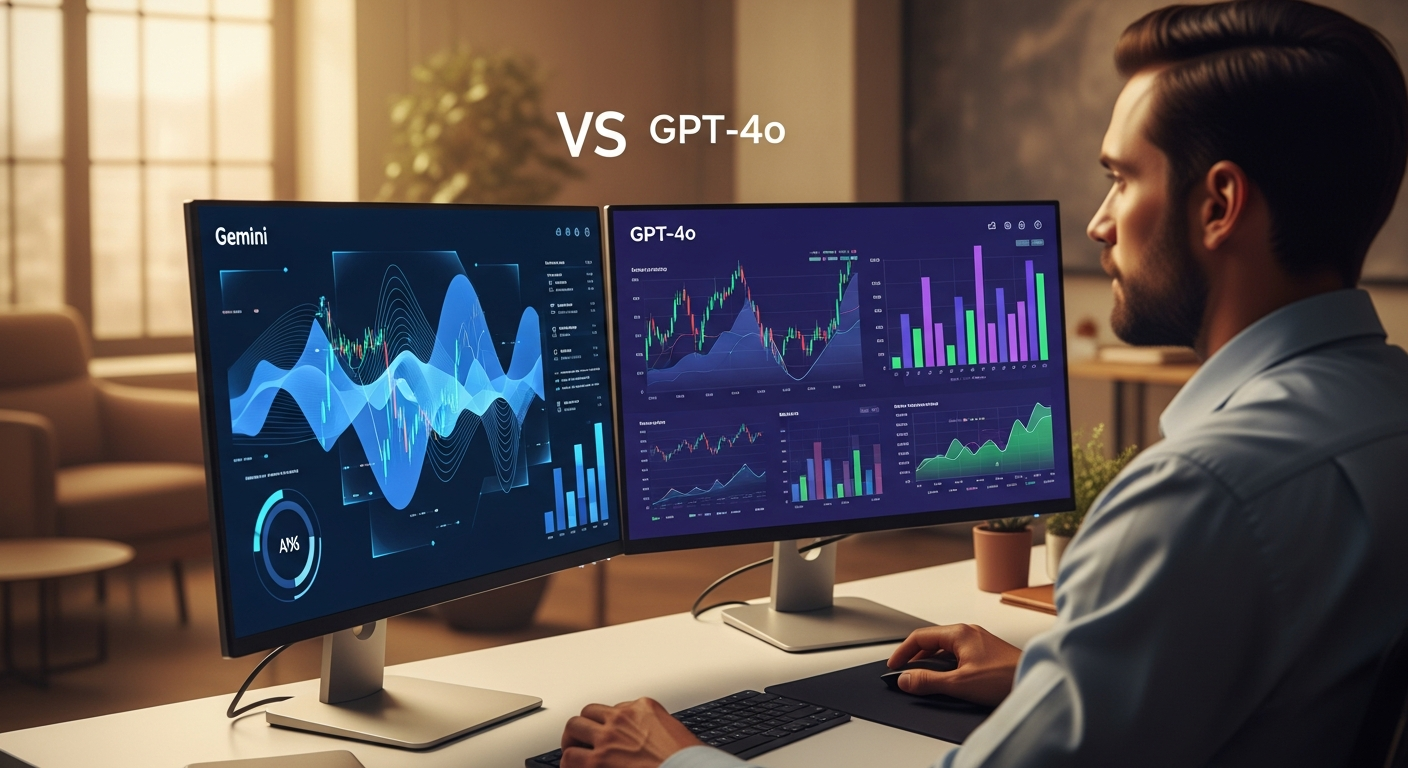
Gemini vs GPT-4o Price Comparison: Strategic AI Investment for Business Leaders
>This page contains affiliate links. We may earn a commission if you make a purchase through these links, at no extra cost to you. This helps support our content.<
The Critical Business Decision: Optimizing Your AI Spend Without Sacrificing Performance
>In today's hyper-competitive business landscape, Artificial Intelligence isn't just a buzzword; it's a strategic imperative. From automating customer service and generating marketing copy to analyzing complex data and empowering developers, Large Language Models (LLMs) like Google's Gemini and OpenAI's GPT-4o are transforming how businesses operate. But here's the challenge: how do you choose the right AI model that delivers maximum value without blowing your budget?<
Many business professionals, C-suite executives, and IT decision-makers grapple with this exact question. You need an AI solution that scales with your ambition, integrates seamlessly with your existing infrastructure, and most importantly, provides a tangible return on investment. The sticker shock of high-performance AI can be daunting, but the true cost isn't just the price tag – it's the total cost of ownership, including integration, latency, token consumption, and the quality of output.
This comprehensive guide cuts through the noise. We'll provide a meticulous, data-driven price comparison between Gemini and GPT-4o, dissecting their cost structures, performance nuances, and ideal use cases. By the end, you'll have a crystal-clear understanding of which powerhouse AI model offers the superior strategic advantage for your specific business needs, empowering you to make an informed, cost-effective decision that drives innovation and profitability.
Quick Comparison: Gemini vs. GPT-4o at a Glance
Before we dive deep, here's a rapid overview to help you quickly grasp the core differences in pricing and key capabilities between these two market leaders. This table focuses on their most comparable, high-performance models for general business applications.

| Feature/Aspect | Google Gemini (e.g., Gemini 1.5 Pro) | OpenAI GPT-4o |
|---|---|---|
| Input Pricing (per 1M tokens) | ~$7.00 (Gemini 1.5 Pro) | ~$5.00 |
| Output Pricing (per 1M tokens) | ~$21.00 (Gemini 1.5 Pro) | ~$15.00 |
| Context Window Size | 1M tokens (up to 2M in private preview) | 128k tokens |
| Modality Support | >Text, Image, Audio, Video (native multimodality)< | Text, Image, Audio (native multimodality) |
| Developer Platform | Google Cloud Vertex AI, AI Studio | OpenAI API, Microsoft Azure OpenAI Service |
| Key Strengths | >Massive context window, native video analysis, cost-effective for large inputs, strong enterprise support via Google Cloud.< | Highly competitive pricing for excellent performance, fast inference, strong multimodal capabilities (vision & audio), broad ecosystem. |
| Ideal For | Complex document analysis, long-form content generation, code analysis, R&D, advanced data extraction, video processing. | Real-time applications, customer service bots, short-to-medium content generation, creative tasks, vision-based applications, rapid prototyping. |
| Free Tier/Access | Gemini 1.5 Flash (for smaller contexts), AI Studio (limited usage) | Limited free access via ChatGPT, API free trial credits |
Note: Prices are approximate and subject to change. Always refer to the official pricing pages for the most up-to-date information. Context window size for Gemini 1.5 Pro can extend up to 2M tokens for specific use cases or through early access programs.
Why This Comparison Matters for Your Bottom Line
The initial price per token is just one piece of the puzzle. Factors like context window size directly impact how many tokens you consume for a given task. A larger context window, like Gemini's 1 million tokens, means you can feed entire books, extensive codebases, or long video transcripts into the model in a single prompt, potentially reducing the need for complex chunking and multiple API calls, thereby saving costs and improving coherence. GPT-4o's lower per-token cost, combined with its speed, might make it more economical for high-volume, shorter-form interactions.
Understanding these nuances is critical for truly optimizing your AI investment.
Detailed Analysis: Unpacking Gemini and GPT-4o for Business Applications
1. Gemini 1.5 Pro: The Contextual Powerhouse
Google's Gemini 1.5 Pro is engineered for enterprise-grade applications requiring deep contextual understanding and multimodal processing. Its standout feature is the colossal 1 million token context window, a game-changer for businesses dealing with vast amounts of information.
- Pricing Structure:
- Input: Approximately $7.00 per 1 million tokens for Gemini 1.5 Pro.
- Output: Approximately $21.00 per 1 million tokens for Gemini 1.5 Pro.
- Gemini 1.5 Flash: A faster, lighter, and significantly cheaper version (e.g., ~$0.35/M input tokens, ~$1.05/M output tokens) perfect for simpler, high-volume tasks where the full power of Pro isn't needed. This offers a fantastic cost-optimization lever.
- Video Processing: Specific pricing applies for video frames, typically around $0.0000025 per frame for 1.5 Pro, which can add up but is revolutionary for video analytics.
- Key Features & Business Advantages:
- Massive Context Window: Imagine feeding an entire legal brief, a year's worth of financial reports, or a 60-minute video into the AI and getting cohesive analysis. This dramatically reduces the need for complex prompt engineering, chunking strategies, and multiple API calls, leading to more accurate and efficient processing. For tasks like code review, long document summarization, or deep research, this is unparalleled.
- Native Multimodality: Gemini 1.5 Pro natively understands and processes text, images, audio, and crucially, video. This isn't just stitching together different models; it's a unified understanding. Use cases include:
- Video Content Analysis: Summarize meeting recordings, extract key actions from training videos, analyze customer interactions from video calls.
- Visual Inspection: Detect anomalies in manufacturing processes from video feeds.
- Customer Experience: Analyze multimodal customer feedback (text, voice, images).
- Function Calling:> Robust function calling capabilities allow Gemini to interact seamlessly with your internal tools and APIs, enabling complex workflows and automation.<
- Enterprise-Grade Security & Scalability: Leverages Google Cloud's Vertex AI platform, offering robust security, compliance, and scalability for large enterprise deployments.
- Gemini 1.5 Flash for Cost Optimization: Businesses can strategically use 1.5 Flash for high-volume, lower-complexity tasks (e.g., basic chatbots, quick summaries) and reserve 1.5 Pro for intensive, high-value operations.
- Use Case Examples:
- Legal & Compliance: Summarizing thousands of pages of legal documents, identifying relevant clauses, or performing due diligence on contracts.
- Financial Services: Analyzing quarterly reports, market trends, and investor calls over extended periods.
- >Software Development:< Analyzing entire code repositories for bugs, vulnerabilities, or generating documentation for large projects.
- Media & Entertainment: Automated content moderation, video summarization, or creating metadata for extensive video libraries.
Strategic Insight: While Gemini 1.5 Pro's per-token output cost is higher, its massive context window often means fewer tokens are needed overall for complex tasks, and the quality of insight from a single, comprehensive prompt can be superior. Factor in the potential savings from reduced engineering effort on prompt chaining and data preparation.
2. OpenAI GPT-4o: The Fast, Cost-Effective Multimodal Performer
GPT-4o (the 'o' stands for 'omni') is OpenAI's latest flagship model, designed for speed, efficiency, and native multimodal capabilities across text, audio, and vision. It aims to deliver GPT-4 level intelligence at a significantly lower cost and higher speed.
- Pricing Structure:
- Input: Approximately $5.00 per 1 million tokens.
- Output: Approximately $15.00 per 1 million tokens.
- Audio Transcription: Whisper model equivalent integration, typically $0.006 / minute.
- Vision: Image processing costs vary based on resolution, typically calculated per image segment or pixel count. For example, a 1080p image might cost around $0.001275 per image.
- Key Features & Business Advantages:
- Highly Competitive Pricing: With input tokens at $5/M and output at $15/M, GPT-4o offers a compelling price-to-performance ratio, making high-quality AI more accessible for a broader range of applications.
- Blazing Fast Inference: GPT-4o is significantly faster than previous GPT-4 models, crucial for real-time applications like live customer support, interactive voice agents, and dynamic content generation.
- Native Multimodality (Text, Audio, Vision): GPT-4o processes these modalities as inputs and generates them as outputs in a unified way.
- Voice Interfaces: Enables highly natural and responsive voice assistants, transcribing speech, understanding tone, and responding with human-like voice.
- Vision Capabilities: Analyze images for content, context, and even subtle nuances, useful for visual search, quality control, or accessibility tools.
- 128k Context Window: While smaller than Gemini 1.5 Pro, 128k tokens is still substantial and sufficient for most common business tasks, including summarizing long articles, generating detailed reports, or handling multi-turn conversations.
- Broad Ecosystem & Tooling: Benefits from OpenAI's extensive API documentation, community support, and integration with Microsoft Azure OpenAI Service, offering robust enterprise features.
- Use Case Examples:
- Customer Support: Powering advanced chatbots and voicebots that can understand complex queries, provide immediate assistance, and even detect customer sentiment.
- Marketing & Sales: Generating personalized marketing copy, email campaigns, and sales pitches at scale, or analyzing visual trends in social media.
- Content Creation: Drafting articles, blog posts, social media updates, and creative content with rapid iteration.
- Accessibility: Describing images for visually impaired users, or converting speech to text and vice-versa in real-time.
Strategic Insight: GPT-4o excels where speed, cost-efficiency for common tasks, and robust multimodal interaction (especially voice) are paramount. Its lower per-token cost makes it highly attractive for high-volume, interactive applications, provided your context window needs don't consistently exceed its 128k limit.
3. The Underlying Infrastructure: Google Cloud vs. Azure/OpenAI
Beyond the models themselves, the underlying cloud infrastructure plays a crucial role in enterprise adoption, security, and integration. Google Gemini is deeply integrated with Google Cloud's Vertex AI, while GPT-4o is available directly via OpenAI's API and also through Microsoft Azure OpenAI Service.
- Google Cloud Vertex AI (for Gemini):
- Strengths: Native integration with Google Cloud's vast suite of services (BigQuery, Dataflow, Kubernetes Engine), strong MLOps capabilities, robust security, and compliance offerings tailored for enterprise. Ideal for organizations already invested in the Google Cloud ecosystem.
- Considerations: May require existing Google Cloud expertise or a willingness to adopt their ecosystem.
- OpenAI API & Microsoft Azure OpenAI Service (for GPT-4o):
- Strengths:> OpenAI's direct API is easy to use for developers. Azure OpenAI Service provides enterprise-grade security, compliance (HIPAA, GDPR), VNET integration, and the ability to leverage existing Azure investments (e.g., Azure Machine Learning, Azure Data Lake). This is a significant advantage for businesses already on Azure.<
- Considerations: Direct OpenAI API might require more in-house security and governance setup for highly regulated industries compared to Azure's managed service.
The choice of platform often dictates the ease of integration, cost of operations, and the level of enterprise support you can expect. Consider your existing cloud strategy when making your decision.
Pricing & Suitability by Business Segment
Understanding which model aligns with your business size, budget, and specific operational needs is key to a successful AI strategy.

Small to Medium Businesses (SMBs)
- Primary Needs: Cost-effectiveness, ease of implementation, quick wins, automation of routine tasks.
- GPT-4o: Often a strong contender due to its lower per-token cost and excellent performance for common tasks like customer support automation, content generation, and internal communication. Its speed makes it ideal for real-time applications without breaking the bank. The direct OpenAI API is straightforward to integrate for smaller teams.
Recommendation: Start with GPT-4o for general-purpose AI tasks. Its affordability and speed offer a high ROI for many SMB use cases. Consider its vision and audio capabilities for enhancing customer interaction or marketing efforts.
- Gemini 1.5 Flash: For SMBs needing a slightly larger context or specific Google Cloud integrations, 1.5 Flash offers a very compelling price point for high-volume, simpler tasks.
Recommendation: If your tasks involve slightly longer inputs or you're already on Google Cloud, Gemini 1.5 Flash is a powerful and very economical option for many daily operations.
Large Enterprises & Corporations
- Primary Needs: Scalability, robust security & compliance, deep integration with existing systems, handling massive datasets, advanced R&D.
- Gemini 1.5 Pro: The go-to for complex data analysis, legal discovery, comprehensive code review, and any application requiring a deep understanding of vast amounts of information. Its 1M+ token context window minimizes engineering overhead for large-scale data processing. The native video understanding is a unique differentiator for industries like media, surveillance, or manufacturing. Google Cloud's enterprise support and MLOps tools are invaluable.
Recommendation: For strategic, high-value, and data-intensive applications where context is king, Gemini 1.5 Pro offers unparalleled capabilities. Its ability to process entire documents or videos in one go can lead to significant efficiency gains and deeper insights, justifying the higher per-token output cost.
- GPT-4o (via Azure OpenAI Service): Excellent for high-volume, real-time enterprise applications, especially where speed and multimodal interaction (voicebots, visual analysis for customer interactions) are critical. For enterprises already heavily invested in Microsoft Azure, integrating GPT-4o through Azure OpenAI Service offers seamless security, compliance, and operational benefits.
Recommendation: Ideal for enhancing customer experience, powering internal knowledge bases, and automating communication workflows at scale, particularly if your organization is an Azure shop. Leverage its speed for interactive applications.
Startups & Innovators
- Primary Needs: Flexibility, rapid prototyping, access to cutting-edge features, cost-efficiency for early-stage development.
- GPT-4o: Its competitive pricing and speed make it ideal for rapid iteration and testing new AI-powered products or features. The broad community support and ease of API access are also beneficial for lean development teams.
Recommendation: Prioritize GPT-4o for developing new, interactive AI applications, especially those leveraging voice or vision, where quick response times and lower costs per interaction are crucial for user experience and budget control.
- Gemini 1.5 Flash & Pro: For startups building solutions that rely on processing extremely long documents, codebases, or video content, Gemini 1.5 Pro offers a distinct advantage. If your innovative product hinges on analyzing vast amounts of data in a single pass, the investment in Gemini 1.5 Pro can be justified by the unique capabilities it unlocks.
Recommendation: Consider Gemini 1.5 Pro if your core innovation requires handling massive contexts or advanced video understanding. Otherwise, Gemini 1.5 Flash provides a very cost-effective entry point into the Gemini ecosystem.
Who Should Use What: Matching AI to Your Role & Goals
The best AI model isn't just about price; it's about alignment with your strategic objectives and daily operational needs. Here's a breakdown by common business personas:
1. The CTO / Head of Engineering
- Goal: Build scalable, performant, and secure AI infrastructure. Optimize resource utilization.
- If you value: Deep integration with Google Cloud, massive context for complex enterprise data, native video analysis, cutting-edge R&D capabilities.
Choose: Gemini 1.5 Pro (via Vertex AI)
- If you value: Best-in-class performance at a highly competitive price, rapid inference for real-time applications, robust Azure integration, strong developer community.
Choose: GPT-4o (via OpenAI API / Azure OpenAI Service)
2. The Head of Product / Product Manager
- Goal: Deliver innovative AI-powered features, enhance user experience, drive product adoption.
- If your product requires: Summarizing extensive user feedback documents, analyzing long-form content, processing video tutorials or user recordings, enabling deep contextual search.
Choose: Gemini 1.5 Pro
- If your product requires: Real-time interactive chatbots, voice assistants, image analysis for user-generated content, rapid content generation for features like personalized recommendations.
Choose: GPT-4o
3. The Head of Marketing / CMO
- Goal: Generate compelling content, personalize customer journeys, analyze market trends, optimize campaigns.
- If you need to: Analyze extensive market research reports, summarize long competitor analyses, generate comprehensive campaign strategies, extract insights from long-form customer testimonials.
Choose: Gemini 1.5 Pro
- If you need to: Rapidly generate diverse marketing copy (social media, ads, emails), create personalized content at scale, power dynamic chatbots for lead qualification, analyze visual trends in social media.
Choose: GPT-4o
4. The Head of Operations / COO
- Goal: Automate processes, improve efficiency, reduce operational costs, enhance decision-making.
- If your operations involve: Processing large volumes of internal documentation, automating complex compliance checks across numerous policies, analyzing long sensor data logs or video feeds for quality control.
Choose: Gemini 1.5 Pro
- If your operations involve: Automating customer support interactions, streamlining internal knowledge bases, generating quick summaries of daily reports, improving communication workflows with voice interfaces.
Choose: GPT-4o
5. The CFO / Finance Director
- Goal: Optimize AI spend, ensure ROI, control costs, forecast budget accurately.
- If your focus is on: Minimizing per-token cost for high-volume, standard tasks, especially if real-time interaction is critical.
Choose: GPT-4o
- If your focus is on: Investing in capabilities that unlock entirely new efficiencies or insights from massive, complex datasets, potentially reducing overall engineering costs for complex data handling.
Choose: Gemini 1.5 Pro (or 1.5 Flash for cost-conscious, high-volume tasks)
Implementation & Getting Started: Your Path to AI Integration
Choosing the right model is the first step. The next is seamless integration into your business workflows. Here’s a high-level guide to get you started with both Gemini and GPT-4o.

Getting Started with Google Gemini (via Vertex AI)
- Set up Google Cloud Project: If you don't have one, create a Google Cloud account and a new project. Enable the Vertex AI API.
- Access Gemini Models: Navigate to Vertex AI Studio in your Google Cloud console. You can access Gemini 1.5 Pro and 1.5 Flash through the "Language" section.
- Experiment in AI Studio: Use the "Prompt Engineering" interface to test models, understand their behavior, and refine your prompts. This is a no-code environment for quick experimentation.
- API Integration: For production workloads, use the Vertex AI SDKs (Python, Node.js, Java, Go) or REST APIs to integrate Gemini into your applications.
- Authentication: Use Google Cloud service accounts for secure API access.
- Token Management: Be mindful of the context window. While 1M tokens is large, efficient prompt design still matters.
- Cost Monitoring: Set up billing alerts in Google Cloud to monitor your Gemini usage and costs.
- Leverage Vertex AI Features: Explore capabilities like fine-tuning (when available for Gemini), ground truth data labeling, and MLOps tools within Vertex AI for advanced deployments.
Ready to unlock the power of Gemini for your enterprise? Explore Google Cloud Vertex AI
Getting Started with OpenAI GPT-4o (via OpenAI API / Azure OpenAI Service)
- OpenAI Account Setup: Create an OpenAI account and generate an API key. For enterprise-grade deployment, consider Azure OpenAI Service.
- Experiment with Playground: Use the OpenAI Playground to test GPT-4o, experiment with prompts, and understand its output characteristics.
- API Integration (Direct OpenAI):
- Libraries: Use the official OpenAI Python library or community-supported libraries for other languages.
- Authentication: Use your API key securely. Best practice is to store it as an environment variable, not hardcoded.
- Rate Limits: Be aware of OpenAI's rate limits and implement retry mechanisms in your code.
- Cost Management: Monitor usage through your OpenAI dashboard and set spending limits.
- API Integration (Azure OpenAI Service):
- Azure Setup: Create an Azure subscription and apply for access to Azure OpenAI Service.
- Resource Deployment: Deploy an OpenAI resource within your Azure subscription, then deploy GPT-4o to it.
- SDKs & APIs: Use Azure's SDKs and REST APIs to interact with your deployed model, benefiting from Azure's enterprise-grade security and networking features.
- Integration with Azure Services: Seamlessly connect with Azure Data Lake, Azure Functions, Azure Kubernetes Service, and more.
- Fine-tuning & Customization: Explore OpenAI's fine-tuning capabilities (if applicable for GPT-4o or other models) to tailor the model's responses to your specific domain and style.
Experience the speed and versatility of GPT-4o. Try OpenAI API Explore Azure OpenAI Service
Make Your Strategic AI Investment Today
The decision between Gemini and GPT-4o is not about choosing a "better" model in absolute terms, but about selecting the best fit for your business's unique challenges, budget, and strategic vision. Both are cutting-edge, but their strengths and cost structures cater to different priorities.
If your enterprise deals with vast, complex datasets, requires unparalleled contextual understanding, or needs native video analysis, Gemini 1.5 Pro is your strategic advantage, offering capabilities that can revolutionize data processing and insight generation. If you prioritize cost-efficiency for high-volume, real-time interactions, rapid content creation, and robust multimodal communication (especially voice), GPT-4o delivers exceptional value and speed.
Don't let analysis paralysis hold you back. The future of business is AI-powered, and taking decisive action now will position your organization at the forefront of innovation. Evaluate your core needs, consider the detailed pricing and feature breakdowns above, and make the choice that will drive your business forward.
Ready to transform your business with the right AI?
Compare Gemini 1.5 Pro on Google Cloud Compare GPT-4o on OpenAI API Explore GPT-4o via Azure OpenAI ServiceUncertain which path is right for you? Leverage the free tiers and trials to experiment and see the power firsthand.
Frequently Asked Questions (FAQ)
Q1: Is Gemini 1.5 Pro always more expensive than GPT-4o?
A: Not necessarily. While Gemini 1.5 Pro has higher per-token output costs, its massive 1 million token context window means you might consume fewer tokens overall for complex tasks that would require extensive prompt chaining or chunking with GPT-4o's 128k context. For simpler, high-volume tasks, Gemini 1.5 Flash is significantly cheaper than GPT-4o. The total cost depends heavily on your specific use case, input size, and output requirements.
Q2: Which model is better for real-time applications like chatbots or voice assistants?
A: GPT-4o generally has an edge here due to its faster inference speeds and highly competitive pricing for high-volume interactions. Its native voice capabilities are particularly optimized for responsive, human-like conversations. While Gemini 1.5 Flash offers speed for text, GPT-4o's multimodal speed is a strong differentiator for interactive experiences.
Q3: Can I use both Gemini and GPT-4o in my organization?
A: Absolutely. A common strategy for large enterprises is to adopt a multi-model approach, leveraging each model's strengths. For instance, use Gemini 1.5 Pro for deep document analysis and R&D, and GPT-4o for customer-facing chatbots, internal knowledge retrieval, and rapid content generation. This allows for optimal cost-efficiency and performance across diverse use cases.
Q4: How important is the context window size for my business?
A: Extremely important, depending on your data. If your business deals with lengthy documents (legal contracts, research papers, entire codebases), long customer interactions, or video content, Gemini 1.5 Pro's 1 million token context window is a significant advantage. It allows the model to process and understand vast amounts of information in a single request, leading to more coherent outputs and reducing the complexity of your engineering efforts. For shorter, more transactional interactions, GPT-4o's 128k context is usually more than sufficient.
Q5: What are the main considerations for data privacy and security?
A: Both Google (Vertex AI) and OpenAI (especially via Microsoft Azure OpenAI Service) offer robust enterprise-grade security and compliance features.
- Google Cloud Vertex AI: Benefits from Google Cloud's extensive security infrastructure, data residency controls, and compliance certifications (e.g., ISO 27001, SOC 1/2/3, HIPAA, GDPR). Data submitted to Gemini via Vertex AI is not used to train Google's public models.
- Microsoft Azure OpenAI Service: Provides enterprise-level security, private networking (VNET integration), data encryption, and compliance with industry standards. Data processed through Azure OpenAI Service is not used by Microsoft or OpenAI to train models.
Q6: Are there any free tiers or ways to test these models before committing?
A: Yes!
- Google Gemini: Gemini 1.5 Flash has a generous free tier for limited usage in AI Studio and Vertex AI. You also typically receive free credits when signing up for Google Cloud.
- OpenAI GPT-4o: OpenAI offers free API credits to new users, and the ChatGPT interface (which often runs on underlying GPT-4o or similar models) has a free tier for basic usage.
Q7: How do these models handle different languages?
A: Both Gemini and GPT-4o are highly multilingual models, capable of understanding and generating text in a wide array of languages. They have been trained on diverse datasets that include many languages. Gemini, being a Google product, often benefits from Google's extensive research and data in multilingual processing. GPT-4o also demonstrates excellent performance across various languages. For critical applications in specific languages, it's always prudent to conduct dedicated testing to ensure the desired quality and nuance.