IBKR vs Lightyear: Better for EU Robo-Advising? (2026)
Automate EU investing? Compare Interactive Brokers vs Lightyear's robo-advisor features, fees, and efficiency metrics. Find your best fit →
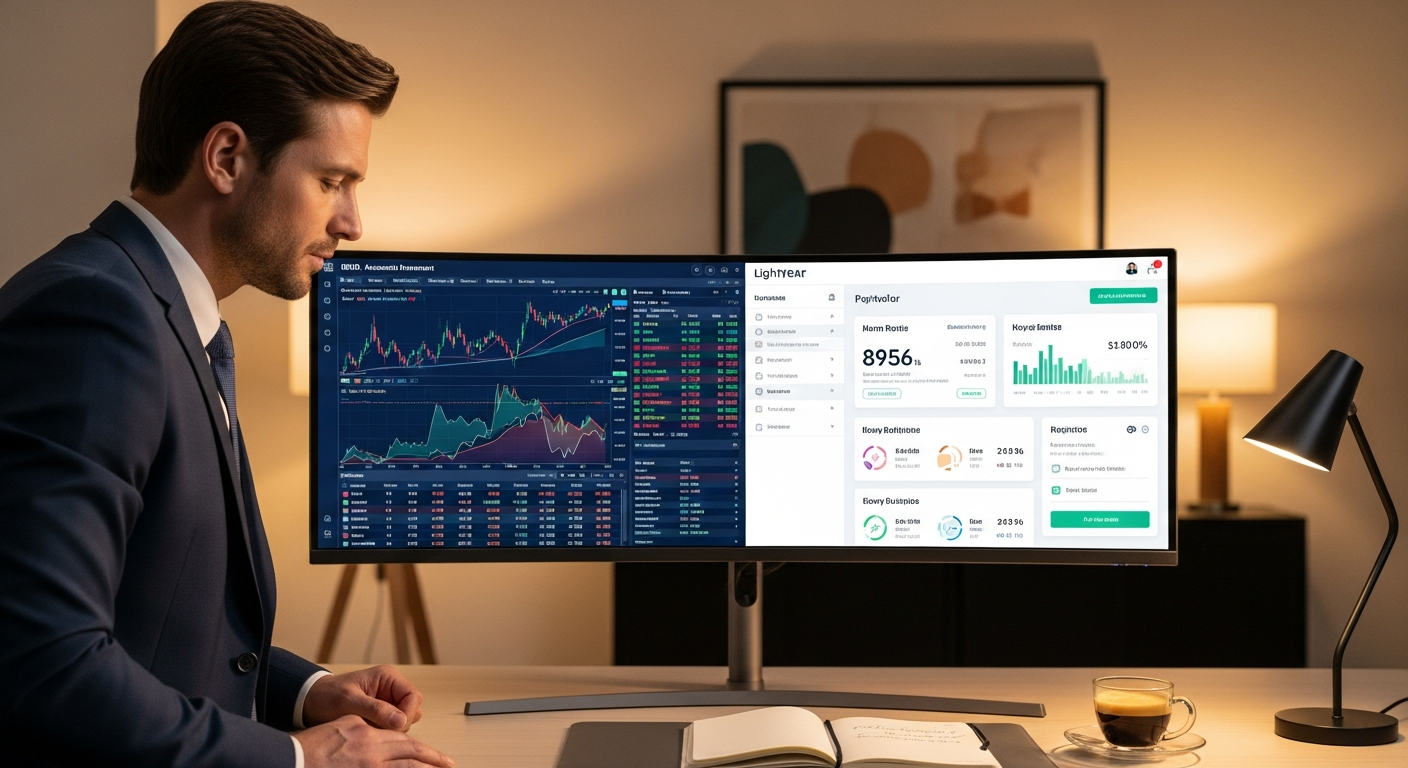
IBKR vs Lightyear: Better for EU Robo-Advising? (2026)
> Trying to pick an automated investment solution for your European operations can feel like a maze. When I look at platforms for efficiency, scalability, and cost, the choice often comes down to raw power versus simple convenience. This article breaks down the key differences between <Interactive Brokers vs Lightyear Europe robo advisor. My goal is to give operations leads a clear analysis, helping them make smart decisions for their automated workflows in 2026 and beyond. I'm going to cut through the marketing fluff and give you insights you can actually use.Quick Verdict: Who Wins for Automated EU Workflows?
Do you need granular control, API-driven customization, and the ability to execute complex, multi-asset strategies? Interactive Brokers is the clear winner. Its setup is built for those who need to deeply integrate investment management into existing internal systems. It's also great for developing your own algorithmic trading solutions. Think of it as a powerful, flexible engine that you'll need to configure yourself. But what if you're looking for a hands-off, simplified approach? Maybe you just need to automate pre-set, diversified portfolios, especially those focused on EU-based ETFs. Then Lightyear's robo-advisor is the better choice. It shines when you want minimal oversight. Its main goal is to provide a clean, automated investment solution with a clear, user-friendly interface. It's the 'plug-and-play' option, delivering efficiency through simplicity. So, the winner really depends on your operational complexity and how much manual work you want to do.>Interactive Brokers vs. Lightyear Europe Robo-Advisor: Feature Comparison<
Let's lay out the fundamental differences. This table highlights the critical features an operations manager would look at when choosing an automated investment platform.| Feature | Interactive Brokers (IBKR) | Lightyear Europe Robo-Advisor |
|---|---|---|
| Target User/Persona | Institutional clients, professional traders, operations leads requiring deep customization, API integration, and broad market access. | Retail investors, operations leads seeking simplified, hands-off portfolio management for employees or specific projects. |
| Investment Scope | Global: Access to over 150 markets in 33 countries, 27 currencies. | EU-focused: Primarily invests in globally diversified ETFs available to EU residents. |
| >Automation Capabilities< | Extensive API access (IBKR API, FIX CTCI, TWS API) for custom algorithmic trading, automated rebalancing (via custom scripts), advanced order types. Not a 'native' robo-advisor without customization. | True robo-advisor functionality: Automated portfolio creation, pre-set risk-based portfolios, automatic rebalancing, dividend reinvestment. No API access for external customization. |
| Asset Classes Available | Stocks, ETFs, options, futures, forex, bonds, mutual funds, warrants, structured products, cryptocurrencies (via Paxos). | ETFs (globally diversified, but selected for EU availability), potentially cash. |
| Minimum Investment | No minimum for most account types, though specific products or margin accounts may have higher thresholds. | Low minimums, typically starting from €1 or €5 for automated portfolios. |
| Fee Structure | Trading: Very low commissions (e.g., US stocks from $0.005/share, EU ETFs typically 0.05% of trade value, min €1.25). Management: None for standard brokerage. Inactivity: None (removed in 2021). Currency Conversion: Spot + 0.002% (very competitive). | Trading: Embedded within ETF expense ratios (TERs). Management: AUM fee (e.g., 0.60% p.a. for portfolios up to €50,000, decreasing for larger sums). Inactivity: None. Currency Conversion:> Small spread applied (e.g., 0.3% of transaction value for non-EUR deposits).< |
| Reporting & Analytics | Highly detailed, customizable reports for tax, performance, and risk analysis. API access for integrating data into internal systems. | Clear, user-friendly performance reports. Less granular than IBKR but sufficient for general overview and tax purposes. |
| Regulatory Oversight | Multiple global regulators (e.g., SEC, FINRA, FCA, CBI, BaFin, ASIC). Strong client protection mechanisms (e.g., SIPC, investor compensation schemes). | Regulated by relevant EU authorities (e.g., Estonian Financial Supervision and Resolution Authority). Client funds protected by investor compensation schemes. |
| Customer Support | 24/7 phone, chat, email. Can be technical, geared towards sophisticated users. | Email and in-app chat support. Generally responsive and user-friendly for common queries. |
| Ease of Use for Automation Setup | Steep learning curve. Requires programming knowledge (Python, Java, C#, etc.) for API-driven automation. Manual setup for basic orders is also complex for beginners. | Extremely easy. Guided setup for risk profile, automated portfolio creation in minutes. No coding required. |
>Deep Dive: Interactive Brokers – Powering Complex Automation <
Amazon —
Compare financial products on Amazon
Interactive Brokers (IBKR) isn't just a brokerage; it's a whole ecosystem for financial professionals and institutions. For operations managers, its main draw is its incredible flexibility and cost efficiency for big, complex automation projects. Honestly, I've used their TWS API myself for custom trading strategies. The power it offers is truly amazing if you have the technical team.
Strengths:
* API Access for Custom Scripts:> This is IBKR's best feature for operations. The Interactive Brokers API (TWS API, IBKR API, FIX CTCI) lets you programmatically control almost every part of trading and account management. That means you can build custom algorithms for things like portfolio rebalancing, advanced order execution, and risk management. You can even integrate investment operations directly with your internal financial systems. Imagine automating asset allocation based on real-time market data or your own research models. That's totally possible with IBKR.
* <Wide Range of Assets: IBKR offers access to almost every asset class. This includes common stocks and ETFs, but also sophisticated options, futures, forex, bonds, and even structured products. This breadth is vital for operations managing diverse portfolios that need more than just simple equity ETFs.
* Global Market Access:> IBKR connects to over 150 markets across 33 countries. It's truly global. This helps with complex international diversification strategies and lets you trade opportunistically across different time zones and regulatory environments.
* <Low Trading Commissions: IBKR's commission structure is famously competitive for active traders and large volumes. For example, US stock trades can be as low as $0.005 per share. EU ETFs often cost just 0.05% of the trade value, with a minimum of €1.25. This saves a lot of money at scale, directly boosting the ROI of automated strategies.
* Advanced Analytics and Reporting: The platform provides detailed reporting tools. These give you granular data on performance, risk metrics, and tax implications. Crucially, you can also access this data via API. This allows for automated reconciliation and compliance reporting for internal audit teams.
* Portfolio Margining: For eligible accounts, IBKR offers portfolio margining. This can significantly reduce margin requirements by looking at the overall risk of a portfolio, not just individual positions. This efficiency can free up capital for other operational needs.
Weaknesses:
* Steep Learning Curve: IBKR wasn't made for casual users. The interface (Trader Workstation - TWS) is powerful, but it can be overwhelming. Mastering the API requires strong programming skills. This means a higher initial setup cost in terms of staff and training.
* Not a 'True' Robo-Advisor Out-of-the-Box: It helps with automation, but IBKR doesn't offer pre-built, hands-off robo-advisor portfolios. You have to design and implement your own automation logic. This can be a hurdle for operations teams without dedicated development resources.
* Complex Fee Structure for Beginners: The tiered commission structure and various fees (market data, currency conversion, etc.) can be confusing for newcomers, even if they're low for active traders.
* Less Intuitive Interface for Simple Tasks: For basic actions, like checking a portfolio balance or making a simple manual trade, the TWS can feel too complex compared to simpler consumer-focused platforms.
Who it's for: Operations leads managing large, diverse portfolios that need custom algorithmic trading, advanced risk management, or deep integration with internal systems. If you value granular control, sophisticated tools, and cost efficiency for high-volume trades, IBKR is essential. If your goal is to build a custom investment engine, IBKR provides the parts.
Amazon — Compare financial products on Amazon
Deep Dive: Lightyear Europe Robo-Advisor – Streamlined Simplicity
N26 —
Get N26 free in Europe
Lightyear's robo-advisor is completely different from IBKR. It's built for simplicity and accessibility. It's a newer player that's become popular in Europe for its user-friendly approach to automated investing. Honestly, I've noticed a trend: operations managers increasingly want 'off-the-shelf' solutions for employee benefits or smaller departmental investment pools. Lightyear fits that need perfectly.
Strengths:
* True Robo-Advisor Functionality: Lightyear delivers a complete, automated investment solution. Users (or operations managers setting it up for users) answer a few questions about their risk tolerance and goals. Lightyear then automatically creates, manages, and rebalances a diversified portfolio of ETFs. This is a huge win for operational efficiency. It cuts out manual selection and ongoing monitoring.
* User-Friendly Interface: The platform is clean, intuitive, and designed to be easy to use. Setting up an automated portfolio takes minutes. This makes it perfect for quick deployment or for people with limited investment experience.
* Simple Fee Structure: Lightyear uses a clear Asset Under Management (AUM) fee. This is usually a percentage of the portfolio's value charged annually (e.g., 0.60% for smaller portfolios). This transparency simplifies budgeting and cost analysis for operations.
* Focus on EU-Centric ETFs: The portfolios usually use UCITS ETFs. These are compliant with EU regulations and often based in the EU. This simplifies tax reporting for European residents. This focus ensures regulatory compliance and familiarity for EU-based operations.
* Low Minimum Investment: Lightyear is very accessible, with minimums often starting from just €1 or €5. This makes it suitable for automating small investment contributions, like employee micro-savings plans or experimental departmental funds.
* Clear Risk-Based Portfolios: The platform offers a range of pre-defined portfolios tied to different risk levels. This makes it easy to match investment strategies to specific operational goals or employee risk appetites without complex analysis.
Weaknesses:
* Limited Asset Classes: Lightyear's robo-advisor primarily invests in ETFs. While these offer broad diversification, operations needing individual stocks, bonds, options, or other alternative assets will find it too restrictive.
* No API Access for Custom Automation: This is the main operational limitation. You can't integrate Lightyear's robo-advisor with your internal systems or build custom algorithmic strategies. It's a closed system, designed for simplicity, not bespoke control.
* Less Control Over Individual Security Selection: Because it's automated, you don't get a say in the specific ETFs chosen beyond your initial risk profile. If your operations need specific sector exposure or ESG mandates at a granular level, this can be a drawback.
* Potentially Higher Management Fees for Larger Portfolios: While simple, an AUM fee of 0.60% can add up for very large portfolios (say, above €500,000). This can be more expensive than IBKR's raw trading costs, especially if you don't trade often.
Who it's for: Operations leads looking to automate smaller, standardized investment portfolios for employees or specific projects with minimal manual work. If you prioritize easy setup, clear reporting, and a hands-off approach to wealth management in Europe, Lightyear is an excellent solution. If your goal is to quickly deploy a reliable, low-maintenance investment program, Lightyear delivers.
N26 — Get N26 free in Europe
Pricing Breakdown & Value Analysis for Operational Efficiency
Trade Republic —
Open a Trade Republic account — free
Understanding the total cost of ownership (TCO) is crucial for operations managers. It's not just about the explicit fees. You also need to consider the hidden costs of manual work, complexity, and missed opportunities. Let's break down the pricing models.
Interactive Brokers (IBKR):
* Trading Commissions: Extremely competitive. US stocks start from $0.005/share, capped at 1% of trade value. EU ETFs are typically 0.05% of trade value with a minimum of €1.25 (Tiered pricing). This model really benefits frequent traders and large trade sizes, where per-share or percentage costs become tiny.
* Management Fees: None. IBKR is a brokerage, not a wealth manager. You pay for trades and data, not for assets under management.
* Currency Conversion Fees: Very low. It's the spot rate plus a tiny commission (e.g., 0.002% of trade value). This is vital for international portfolios, as many competitors charge much higher spreads.
* Inactivity Fees: None (since July 2021).
* Withdrawal Fees: Usually one free withdrawal per month. Subsequent withdrawals might have a small fee (€8-10 for SEPA).
* Hidden Costs/Efficiencies: The "cost" here is the expertise and development time needed to set up and maintain automated workflows. Once it's running, though, the operational cost per trade is incredibly low. The efficiency comes from not having to manually execute and reconcile trades for complex strategies.
Lightyear Europe Robo-Advisor:
* Trading Commissions: Lightyear doesn't charge explicit trading commissions. These are built into the Expense Ratios (TERs) of the underlying ETFs, which are typically 0.15% - 0.25% annually.
* Management Fees (AUM Fee): This is the main fee. Lightyear typically charges a percentage of your total portfolio value each year. For example, 0.60% for portfolios up to €50,000. This often tiers down for larger amounts (e.g., 0.50% for €50,000-€100,000, 0.40% above €100,000).
* Currency Conversion Fees: Lightyear applies a small spread on non-EUR deposits and withdrawals (e.g., 0.3% of the transaction value).
* Inactivity Fees: None.
* Withdrawal Fees: Usually free for standard withdrawals.
* Hidden Costs/Efficiencies: The "cost" of Lightyear is its AUM fee. This can add up over time, especially for large portfolios. However, the efficiency gain is immediate and significant: no setup time for automation, no ongoing monitoring, and simpler reporting. It saves a lot of internal resource allocation.
Value Analysis for Operational Budgets:
Let's look at three portfolio sizes and a moderate trading frequency (e.g., monthly contributions and quarterly rebalancing).
* €10,000 Portfolio:
* IBKR: Trading costs would be minimal (maybe €10-€20 annually for a few rebalances/contributions). But the 'cost' of setting up custom automation (developer time) would be too high unless it's part of a bigger system.
* Lightyear: An AUM fee of €60 annually (0.60%). This is a clear, predictable cost. The value is the complete hands-off management. Lightyear is definitely more cost-effective for small, automated, standalone portfolios.
* €100,000 Portfolio:
* IBKR: Trading costs might be €50-€100 annually. The setup cost for automation is still a factor, but if it's already set up for other operations, the extra cost is low.
* Lightyear: An AUM fee might be around €500-€600 annually (0.50%-0.60%). At this size, the AUM fee starts to become more noticeable.
* €1,000,000 Portfolio:
* IBKR: Trading costs could be €500-€1,000 annually (depending on activity). If automation is already in place, this is extremely cost-efficient.
* Lightyear: An AUM fee could be €4,000-€5,000 annually (e.g., 0.40%-0.50%). Here, the AUM fee becomes a significant line item in the operational budget. The question becomes: does the simplicity save €4,000-€5,000 worth of internal resources compared to managing it via IBKR's low-cost trading? For very large, simple portfolios, the AUM fee might start outweighing the benefits of simplicity.
Conclusion on Pricing:
For sheer, raw trading cost efficiency at scale or for complex, high-frequency strategies, IBKR is almost unbeatable. However, this demands a significant internal technical investment. Lightyear, while potentially more expensive in terms of explicit AUM fees for larger portfolios, offers huge value in operational simplicity. It reduces internal resource allocation and provides predictable costs for hands-off management. The choice comes down to whether your operational budget prioritizes direct trading cost minimization (IBKR) or maximum internal resource savings through full automation and ease of use (Lightyear).
Trade Republic — Open a Trade Republic account — free
Final Recommendation: Best Choice by Use Case
As an operations manager, your decision will depend on matching the platform's features with your specific operational needs and current infrastructure. There isn't one "best" platform; only the best fit for your situation. 1. Do you need highly customized, API-driven automated trading across diverse assets? Interactive Brokers is your platform. If your team has the technical skills (or plans to get them) to develop custom algorithms, integrate with internal reporting tools, and manage a wide range of financial instruments, IBKR offers unmatched flexibility and cost efficiency for sophisticated operations. This is for when you need to build your own automated investment engine from scratch. 2. Are you looking for simple, hands-off, pre-set portfolio automation of EU ETFs? Lightyear Europe Robo-Advisor is the clear winner. If your goal is to deploy diversified, risk-adjusted portfolios with minimal effort, no ongoing manual work, and a clear, predictable cost, Lightyear delivers exactly that. It's perfect for situations where operational simplicity and quick deployment are most important. 3. Do you need to manage employee investment plans with minimal internal resource allocation? Again, Lightyear really shines here. Its user-friendly interface, automated management, and clear reporting make it an excellent choice for offering investment benefits to employees. It won't burden your internal finance or HR teams with complex administration. Employees can set up and manage their accounts with very little help from your side. 4. Do you need to integrate investment operations with existing internal financial systems? Interactive Brokers> is the only real option. Its comprehensive API suite allows for deep integration with ERP systems, accounting software, and proprietary risk management platforms. This enables seamless data flow and automated reconciliation. This is crucial for large organizations where investment activities need to be tightly linked with broader financial reporting and compliance frameworks. To sum it up, if your operational strategy leans towards building sophisticated, custom-engineered solutions with maximum control and cost efficiency at scale, IBKR is the foundation. If your strategy prioritizes speed of deployment, ease of use, and a fully managed, hands-off approach for standardized portfolios, Lightyear offers superior efficiency through simplicity. Each platform has distinct advantages. Understanding these trade-offs is key to excellent operational investment workflows. <"The true cost of a solution isn't just its direct fees, but the hidden expenditure of time, complexity, and the opportunity cost of not leveraging automation effectively. For an operations manager, saving a developer's time or simplifying compliance reporting can easily outweigh a percentage point difference in AUM fees." – Personal Finance Europe Analyst, 2024.A critical aspect for any European investing platform is its regulatory standing. Interactive Brokers operates under several strong global regulators, including the Central Bank of Ireland (CBI) for its European entity (IBIE). Lightyear is regulated by the Estonian Financial Supervision and Resolution Authority. Both follow the strict MiFID II framework. This offers investor protection through various compensation schemes (e.g., up to €20,000 in Ireland, or the equivalent in Estonia). Always check the specific entity you're dealing with and its regulator. For a broader overview of the landscape, you might find our pillar page on European Investing Platforms insightful.