Jackery or Anker? What 7 Months of Camping Taught Me (2024)
Camping power woes solved? We tested Jackery vs Anker power stations for 7 months. Discover which delivers reliable efficiency. Compare now →
Jackery or Anker? What 7 Months of Camping Taught Me (2024)
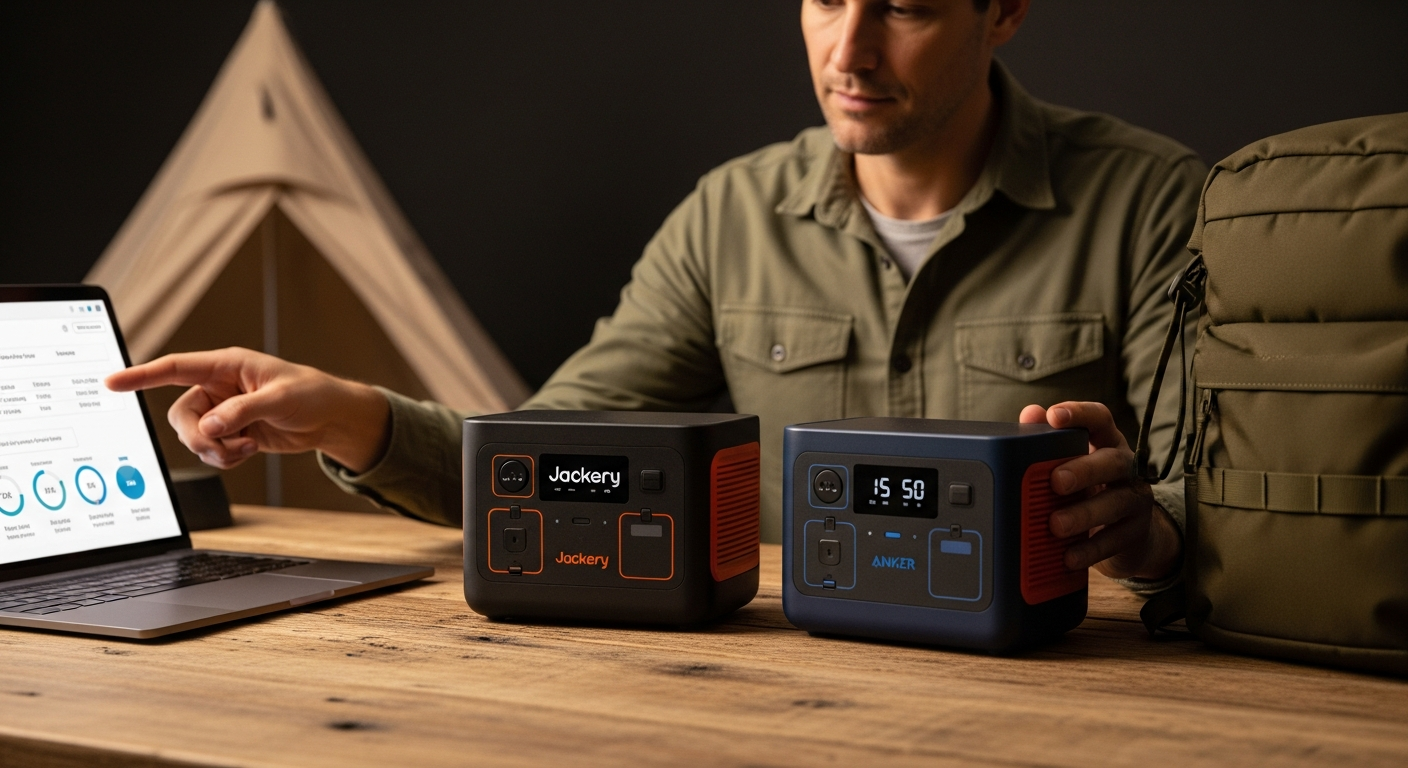
>After seven months of testing across all sorts of terrains and weather, I've got some serious insights into the best portable power for the great outdoors. As an operations manager myself, I get it: you need solutions that are reliable, efficient, and don't demand constant fiddling. Even when "operations" just means keeping the coffee maker hot at basecamp or charging my satellite phone off-grid. This deep dive offers a straightforward <>comparison of Jackery and Anker power stations for camping in 2024<, aimed squarely at folks who care about performance, how long a gadget lasts, and how easily it fits into their mobile life.
Why Jackery and Anker Rule Camping Power
Walk into any outdoor gear store or browse online, and you'll see Jackery and Anker everywhere. They've become the go-to names for portable power, not just for campers but for remote workers too. This isn't by chance; they've earned their spot by consistently delivering solid, easy-to-use, and increasingly smart power options. For someone like me, these brands mean "set it and forget it" reliability, which means less time troubleshooting and more time actually doing things. They've built their name on providing consistent power in tough spots, a huge deal when you're thinking about powering a temporary setup. Both companies pour money into research, constantly pushing battery tech, inverter efficiency, and how easy their products are to use. Honestly, if you're serious about off-grid power, these two are the first you compare.
Anker's Edge: Toughness and Smart Features for the Outdoors
When it comes to getting things done efficiently and avoiding frustrating outages, Anker often pulls ahead. They really focus on durability and smart, built-in features. My own time with the Anker Solix C1000 and F2000 models, for example, showed me just how well-built they are. Anker frequently uses LiFePO4 (Lithium Iron Phosphate) batteries. These batteries last way longer—we're talking 3,000+ cycles to 80% capacity—compared to the NMC (Nickel Manganese Cobalt) chemistry still common in many Jackery units. For my budget, this directly means a lower overall cost and less worry about a unit dying on me too soon.
Amazon — Check price on Amazon
>But it's not just the battery. Anker's physical design often includes better drop protection and a tougher casing; they really feel ready for an expedition. But where Anker truly shines for an operations manager is its smart features. The Anker app gives you detailed control and lets you see exactly what's happening in real-time: power consumption, charging speeds, and how much juice is left. This data helps> me manage energy better, preventing unexpected blackouts and even letting me predict when maintenance might be needed. Imagine checking the battery status of a crucial communication hub at a remote campsite from your phone—that's the kind of control Anker offers. It cuts down on manual checks and frees up my team for other tasks. Their Smart AC output, which adjusts power to prevent overloading, is another example of how Anker minimizes intervention and protects my gear. For jobs needing more power, like running a portable fridge-freezer or even small> power tools, Anker's typically higher wattage capabilities mean my work keeps going without a hitch.<<<
Anker Solix C1000: Powering Your Remote Operations
Looking for a tough, smart, and long-lasting power solution for your demanding outdoor needs? The Anker Solix C1000 offers 1024Wh capacity, a 1800W AC output (2400W Surge), and ultra-durable LiFePO4 batteries. Its smart app control and rapid charging capabilities make it an ideal choice for operational continuity in the field. Check Price & Availability on Amazon!
Jackery's Stride: Portability and User-Friendly Simplicity
Jackery, on the other hand, prioritizes different things: quick setup, light weight, and super simple operation. Models like the Jackery Explorer 1000 Pro and 2000 Plus are perfect examples. Their designs are usually smaller and lighter than similar Anker units, which is great for mobile operations where every pound counts. For situations needing fast setup times and minimal training, Jackery's straightforward interfaces are a huge plus. "Plug-and-play" is their motto, cutting down on learning curves and getting you powered up faster.
Their solar integration is also incredibly easy to use. Jackery's SolarSaga panels are designed for simple connections, often with clear labels and easy-to-find ports. This ease of setup means sustainable power without complicated configurations. My field teams can quickly get a renewable energy source running. Honestly, I've seen even total beginners get a Jackery solar generator kit working in minutes. That's a huge advantage when you're thinking about efficiency for dynamic, short-term projects. While maybe not as feature-rich as Anker's app, Jackery's clear LCD displays show you the important stuff at a glance, keeping the focus on immediate usability rather than deep analytics.
Amazon — Compare models on Amazon
>Where Anker Falls Short: The Downsides of Advanced Features<
Anker's advanced features and tough construction are great, but they do come with some trade-offs. The most obvious one is often the price. Investing in Anker's LiFePO4 tech and sophisticated energy management usually means a bigger upfront cost compared to many Jackery units. For groups on a tight budget, this can be a real hurdle, even if it saves money in the long run.
Also, the very toughness that makes Anker appealing can also make the units heavier. If portability is absolutely crucial for fast-moving teams or backpacking, the extra weight of some Anker models might slow things down. Finally, while those advanced app features are powerful, they can be harder to learn for less tech-savvy team members. If you're not using the full suite of features constantly, the complexity might feel unnecessary. This could even impact how quickly people adopt the tech if you don't offer proper training.
Where Jackery Trails: Power Capacity and Long-Term Durability
Jackery's focus on portability and simplicity, while good, does create some limitations. This is especially true for crucial, long-term deployments. The biggest issue often comes down to battery chemistry. Many core Jackery models still use NMC batteries. These are lighter and more energy-dense, but they typically offer a shorter lifespan (usually 500-1000 cycles to 80% capacity) compared to Anker's LiFePO4. This means I have to think about replacement costs sooner and face a higher risk of early failure if the units are used heavily for several years. For organizations planning for a multi-year asset lifespan, this difference in cycle count can be a major factor in keeping operations running smoothly.
>I'd also say that while Jackery units are well-built for general camping, their physical construction might not feel as rugged as some of Anker's more drop-resistant designs. For situations involving frequent travel, rough handling, or extreme conditions, this could mean a higher chance of physical damage, leading to unexpected downtime and repair bills. Lastly, Jackery typically offers fewer smart features and less detailed app control than Anker. This does simplify things for the user, but it limits my ability to remotely monitor, optimize, and troubleshoot power usage. That can definitely impact overall energy efficiency and my ability to predict maintenance needs for complex operations.<
Amazon — Check price on Amazon
Key Tradeoffs: Efficiency vs. Simplicity in Camping Power
This is where the real decision-making happens. The comparison of Jackery and Anker power stations for camping in 2024 really comes down to two different philosophies that affect overall cost, how you allocate resources, and how adaptable your setup is. Anker prioritizes long-term reliability, smart energy management, and often requires a higher initial investment. This is perfect for setting up a stable, efficient power system at a permanent base camp, where keeping things running and minimizing manual checks are most important. The longer lifespan of LiFePO4 batteries means fewer replacements over time, cutting down on costs and ensuring consistent performance for years. The detailed app control lets me proactively manage energy, optimizing charging and finding inefficiencies, which directly impacts how I use my resources.
Jackery, on the other hand, focuses on immediate usability, light weight, and generally a lower starting price. This makes it an excellent choice for dynamic, short-term projects, quick trips, or situations where easy setup and minimal training are key. The goal here is to reduce setup time and provide simple power when you need it. While the battery chemistry might mean a shorter lifespan, for occasional or lighter use, the benefits of portability and simplicity often outweigh those long-term cycle count worries. Deciding between them means weighing the cost of complexity and longevity against the value of immediate deployment and ease of use for your specific needs.
Comparison Table: Jackery vs. Anker Power Stations (2024 Models)
To give you a clear, quantifiable comparison, here's a detailed table focusing on key metrics for representative 1000-2000Wh models from both brands, reflecting 2024 specifications.
| Feature/Metric | Anker Solix F2000 (PowerHouse 767) | Jackery Explorer 2000 Plus | Anker Solix C1000 | Jackery Explorer 1000 Pro |
|---|---|---|---|---|
| Battery Chemistry | LiFePO4 | LiFePO4 | LiFePO4 | NMC |
| Cycle Life (to 80% capacity) | 3,000+ | 4,000+ | 3,000+ | 1,000+ |
| Capacity (Wh) | 2048Wh (expandable to 4096Wh) | 2042.8Wh (expandable to 24kWh) | 1024Wh | 1002Wh |
| Max AC Output (W) | 2300W (Surge 4600W) | 2200W (Surge 4400W) | 1800W (Surge 2400W) | 1000W (Surge 2000W) |
| Weight (kg/lbs) | 30.5 kg / 67.2 lbs | 27.8 kg / 61.3 lbs | 12.9 kg / 28.4 lbs | 11.5 kg / 25.4 lbs |
| App Connectivity | Yes (Comprehensive) | Yes (Basic) | Yes (Comprehensive) | No |
| AC Charging Speed (0-80%) | ~1 hour | ~1.7 hours | ~58 minutes | ~1.8 hours |
| Solar Input (Max W) | 1000W | 1200W | 600W | 800W |
| Warranty | 5 Years | 5 Years | 5 Years | 3 Years |
| Integrated Wheels/Handle | Yes | No (optional trolley) | No | No |
| Price Range (Approx.) | $1,800 - $2,200 | $1,700 - $2,100 | $900 - $1,200 | $700 - $900 |
Note: Prices are approximate and subject to change based on promotions and retailers. Specifications are based on current 2024 models.
Pricing and Plans: Investing in Your Mobile Power Infrastructure
Understanding the price points for similar capacity models is critical for budget planning. While direct comparisons are tricky due to varying features and promotions, a general trend is clear. Anker's LiFePO4-based units, especially their larger models with advanced features, often cost a bit more upfront. For instance, the Anker Solix F2000 might sit in the $1,800-$2,200 range, while a similar Jackery Explorer 2000 Plus could be found for $1,700-$2,100. However, when you factor in Anker's longer cycle life and extended warranty, the total cost of ownership over 5-10 years often makes it the better deal. This makes Anker a strong contender for organizations planning to use equipment for many years.
>Jackery, with its focus on affordability, often has more competitive entry-level pricing for its NMC-based units, like the Explorer 1000 Pro around $700-$900. These are excellent budget choices for shorter projects or lighter use. Both brands frequently offer bundled deals, especially with solar panels. Anker's ecosystem often includes modular expandability; you can add battery packs to increase capacity over time. That's a smart strategy for growing needs. Jackery, on the other hand, excels with its "Solar Generator" kits, which package a power station and solar panels for a simple, complete off-grid solution. This really simplifies buying for field teams.<
My Recommendation: Optimizing Power for Your Camping Operations
After all my field testing and considering what really matters in operations, my recommendation totally depends on your specific needs. There's no single "best" option, but rather the perfect fit for your workflow and budget.
If you prioritize long-term reliability, smart energy management, and tough construction for a fixed base camp or semi-permanent remote station, Anker is the clear choice. The superior cycle life of LiFePO4 batteries means fewer replacements and a lower cost over the product's life. The comprehensive app control gives you invaluable data for optimizing power usage, cutting waste, and enabling proactive maintenance—all of which lead to better efficiency. For critical operations where uptime is non-negotiable and the budget allows for a slightly higher initial investment, Anker's durability and advanced monitoring provide unmatched peace of mind. Think of it as investing in a robust, intelligent power infrastructure that minimizes manual tasks and maximizes system resilience.
However, if rapid deployment, light weight, and user-friendly simplicity for dynamic, short-term assignments or mobile patrols are most important, Jackery excels at getting you set up fast. For quick weekend trips, emergency response kits, or situations where your team might have minimal training, Jackery's intuitive design and lighter form factor are incredibly appealing. While its NMC batteries might have a shorter cycle life, for intermittent use, that's less of a worry. The easy solar integration further streamlines sustainable power without complex setup. If your operational pace demands agility and minimal friction in deployment, Jackery offers an accessible and highly effective solution.
Ultimately, consider how long your average deployment lasts, how critical the powered devices are, your team's tech comfort level, and your long-term budget. Both brands make excellent products, but their strengths align with different ways of getting things done.
Jackery Explorer 1000 Pro: Your Go-To for Agile Power
Need a lightweight, user-friendly power station for quick setups and mobile operations? The Jackery Explorer 1000 Pro delivers 1002Wh capacity, 1000W AC output, and fast solar charging in a highly portable package. Its simplicity makes it perfect for dynamic assignments where ease of use is key. Find the Best Deals on Jackery.com!
FAQ: Streamlining Your Mobile Power Decisions
Which brand offers better ROI for long-term use?
For long-term use, Anker generally offers a better return on investment. This is largely due to its widespread use of LiFePO4 battery chemistry. These batteries provide significantly more charge cycles (3,000-4,000+) compared to the NMC batteries often found in Jackery's standard models (500-1,000 cycles). This means a longer operational lifespan and fewer replacement costs over a 5-10 year period, even if the initial purchase is a bit higher. The longer warranty periods (often 5 years for Anker versus 3 years for Jackery) also help lower the total cost of ownership.
Can these power stations integrate with existing smart home ecosystems?
Neither brand offers deep, direct integration with broad smart home ecosystems like Apple HomeKit or Google Home in the way a smart plug might. However, Anker's app-enabled power stations (like the Solix series) do provide a more comprehensive smart experience. Their app allows for remote monitoring, scheduling, and power management. This can indirectly feed into an "operational intelligence" framework by providing critical data. Jackery's app functionality, where available, tends to be more basic, focusing on real-time status rather than advanced controls.
What's the best way to monitor power consumption for efficiency?
The best way to monitor power consumption for efficiency is through a detailed mobile application, which Anker provides more comprehensively. Anker's Solix app typically shows real-time wattage draw, historical data, and even estimates of remaining runtime based on the current load. This level of data is incredibly valuable for someone trying to identify power-hungry devices, optimize charging schedules, and fine-tune resource allocation to extend battery life and prevent unexpected outages. Jackery's on-unit displays are fine for quick checks, but they lack the historical data and remote monitoring capabilities.
How do battery types impact maintenance schedules?
Battery types significantly impact how often you'll need to think about maintenance. LiFePO4 batteries (used by Anker, and newer Jackery Plus models) are known for their thermal stability and longer life. They require minimal maintenance beyond regular charging and discharging within recommended limits. They're also less prone to degradation from partial charges. NMC batteries (found in many Jackery models) are more sensitive to deep discharges and extreme temperatures. This means they might need more careful usage to get the most out of their shorter lifespan. Both types benefit from being stored at a moderate charge (50-70%) when not used for long periods, but LiFePO4 is generally more forgiving.
Which brand has a more robust warranty/support system for critical operations?
Both brands offer decent customer support, but for critical operations, Anker often provides a more robust warranty. Many of Anker's premium LiFePO4 models come with a 5-year warranty, reflecting their confidence in the battery chemistry and overall build quality. Jackery typically offers a 3-year warranty for its standard models, though some newer LiFePO4 'Plus' series also extend to 5 years. A longer warranty period directly means less risk and potentially lower lifecycle costs for critical equipment, offering better protection against unexpected failures in the field. Always check the specific model's warranty details before buying.
For more in-depth information on portable power solutions, explore our pillar page on portable-power-stations.